
Introduction
The Mauryan Empire was founded by Chandragupta Maurya. He founded his line of rule out of the last king of Nanda dynasty. He rose to power in about 321 BC. The line of the Mauryan rule was broken in 185 BC when Shungas overpowered them.
Mauryan Empire was the first major kingdom that emerged in Magadha, that spread its rule over large parts of the subcontinent. It is the first Empire in Indian history that had an elaborate administrative system, a large standing military and most features of a centralized state.
It is during the rule of Chandragupta Maurya that Kautilya wrote Arthasastra – the treatise on statecraft of the Mauryan Empire.
Learning Objectives
In this chapter, you will learn about the following topics:
Rise of Magadha
Dynasties and Kings of Magadha
Invasions from Persia and Macedonia
Rise of Magadha
In the beginning of the 6th century BC, northern India consisted of a large number of independent kingdoms which were large states (also known as Mahajanapadas).
The Buddhist literature Anguttara Nikaya gives a list of sixteen kingdoms called Sixteen Mahajanapadas. These were:
Anga, Magadha, Kasi, Kosala, Vajji, Malla, Chedi, Vatsa, Kuru, Panchala, Matsya, Surasena, Asmaka, Avanti, Gandhara and Kambhoja.
Then, from 6th to 4th century BC, Indian political history went through a period of struggle. During this time, four kingdoms – Magadha, Kosala, Vatsa and Avanti – struggled for dominance among themselves.
In the end, Magadha triumphed and arose as the most powerful and prosperous kingdom in North India.
Reasons for the Rise of Magadha
It was advanced in military organization and was the first Indian state to use elephants on a large scale in war.
It had a favourable geographical location and was situated near the richest iron deposits.
It had an immensely fertile soil since it was at the centre of the middle Gangetic plains.
Both of its capitals, Rajagriha and later Pataliputra, had a geographical advantage.
Rajgir was surrounded by hills and could not be seized.
Pataliputra was surrounded by rivers and therefore remained secure from siege.
The society of Magadha was of unorthodox character. It was racially mixed and was enthusiastic about expansion of the kingdom.
Dynasties and Kings of Magadha
It is during the reign of Bimbisara that Magadha rose to power and prominence. Bimbisara began his expansion of Magadha by defeating the neighbouring kingdom of Anga. He belonged to Haryanka clan.
Thus, Haryanka dynasty was the first to rule Magadha. This was followed by Shishunagas and Nandas.
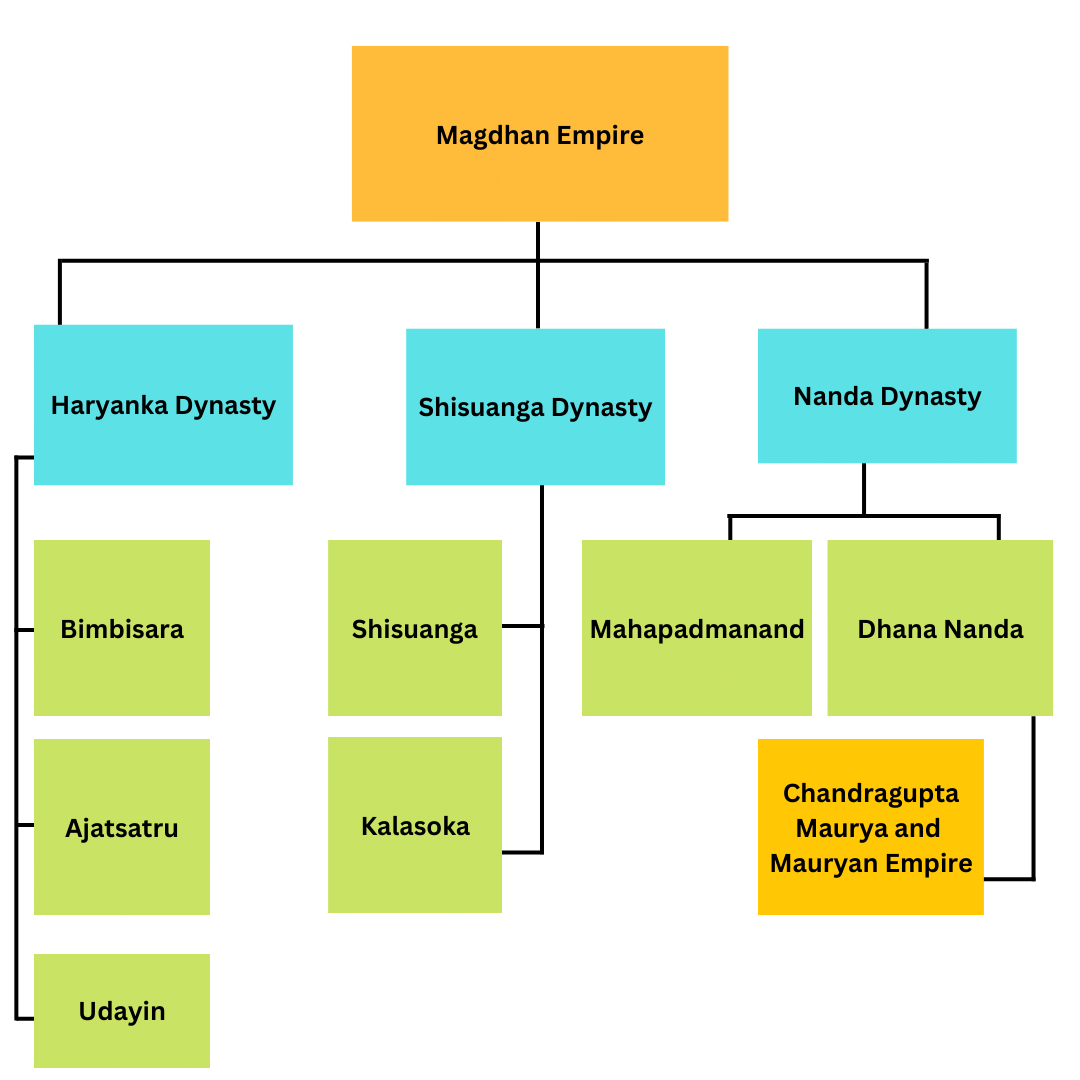
Dynasties of Magadha
Haryanka Dynasty
Kings: Bimbisara, Ajatashatru, Udayin
Shishunaga Dynasty
Kings: Shishunaga, Kalasoka / Kakavarin, Nandivardhan
Nanda Dynasty
Kings: Mahapadmananda, Dhanananda
Haryanka Dynasty
It was founded by Bimbisara after defeating Brahmadatta.
Name of King: Bimbisara
Important Facts
Bimbisara was also known as Seniya or Sreniya for being the first king to have a standing army.
He ruled for 52 years (from 544 BC to 492 BC).
He built Rajgir or Girivraja, the earliest capital city of Magadha.
He was Gautam Buddha’s contemporary and a patron of Buddhism.
He strengthened his position by marriage alliances and diplomatic arrangements.
He had three wives – Mahakosaladevi, Chellana and Khema. They were from the royal family of Koshala, Lichchhavi and Punjab’s Madra clan respectively.
He defeated Brahmadatta of Anga and annexed his kingdom.
He came to an agreement of amity with his most powerful rival Avanti. When Avanti’s king Chandapradota Mahasena suffered from jaundice, he sent his royal physician Jivaka for his treatment.
Name of King: Ajatashatru
Important Facts
Ajatashatru ruled from 492 BC to 460 BC.
He took over the throne by killing his father, Bimbisara. Chellana was his mother.
He followed Jainism.
He married the daughter of King Kosala – Prasenjit after defeating him. Prasenjit was also his maternal uncle.
He devastated Lichchhavi’s capital, Vaishali, after a war that stretched for sixteen years.
Name of King: Udayin
Important Facts
Udayin was Ajatashatru’s son and like him, practiced Jainism.
He reigned from 460 BC to 444 BC.
His reign is important because he built the fort upon the confluence of the Ganga and Son at Patna.
He shifted the capital of Magadha from Rajagriha to Pataliputra (modern-day Patna).
Anuruddha, Munda and Naga-Dasak, who were weaker than him, were his successors.
Note: Naga-Dasak was the last ruler of Haryanka Dynasty.
Shishunaga Dynasty
The period of this dynasty was from 412 BC to 363 BC.
Name of King: Shishunaga
Important Facts
Shishunaga ruled from 412 BC to 395 BC.
He was Naga Dasak’s minister and was elected democratically.
Under his reign, the capital was shifted to Vaishali for a short while.
He brought an end to the hundred-year-old rivalry between Magadha and Avanti by destroying the Pradyota dynasty of Avanti and making it part of Magadha.
Name of King: Kalasoka
Important Facts
Kalasoka ruled from 395 BC to 362 BC.
He convened the 2nd Buddhist Council in Vaishali in 383 BC.
He transferred the capital from Vaishali to Pataliputra.
He was succeeded by Nandivardhan, who was Shishunaga dynasty’s last ruler.
Nanda Dynasty
The period of this dynasty was from 362 BC to 321 BC. It is believed to be the first non-Kshatriya dynasty of the Magadha Empire and sometimes the Nandas are regarded as the ‘first empire builders of Indian history’.
Name of King: Mahapadmananda
Important Facts
Mahapadmananda ruled from around 362 BC to 323 BC.
He founded this dynasty by overthrowing the Shishunaga dynasty.
He assumed the title of ‘Ekarat’ or ‘Eka-chhatra’, the sovereign ruler.
He was considered a great conqueror and was referred to as Sarvakshatrantak or the Uprooter of all Kshatriyas and Ugrasena or Owner of a huge army.
Koshala and Kalinga were conquered by him. He brought the image of Jina as victory trophy from there.
Name of King: Dhanananda
Important Facts
He was the eighth son of Mahapadmananda and the last Nanda ruler.
In the Greek texts, he is referred to as Agrammes or Xan-drames.
During his reign, Alexander invaded North-Western India in 326 BC.
He had a huge army which made soldiers of Alexander refuse from campaigning further towards the Gangetic valley.
He was overthrown by Chandragupta Maurya and Kautilya to establish the Mauryan Empire.
Invasions from Persia and Macedonia
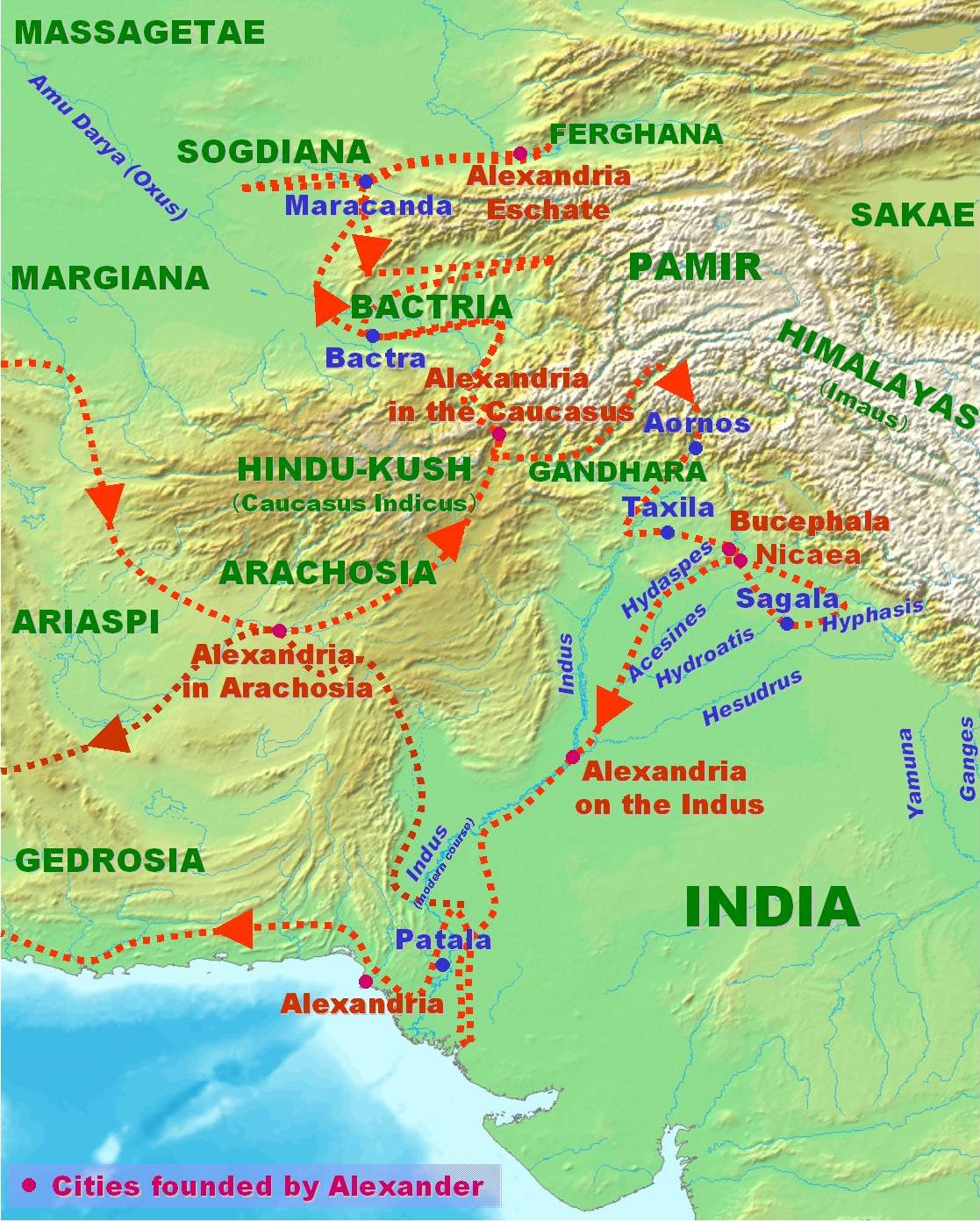
The North West region of the Indian subcontinent during this period of 6th century BC had three small principalities – Kambojas, Gandharas and Madras. These principalities were outside the ambit of kingdoms of Gangetic valley.
The expansion of Achaemenian rulers from Persia happened during this period. Soldiers from these areas also fought in long battle against Greeks. This continued till the invasion of Alexander.
Alexander’s Invasion
Alexander was Macedonia’s (ancient Greece) king and succeeded his father, Philip, in 336 BC at the age of 20.
Under his leadership, Greeks destroyed the Iranian empire during the 4th century.
He took over Kabul and the North-West frontier in 328 BC. Through the Khyber Pass, he moved towards India.
Taxila’s ruler, Ambhi, surrendered to him willingly.
King Porus of the Hindu Paurava kingdom opposed him strongly.
Alexander defeated Porus in the battle of Hydaspas in 326 BC on the banks of the river Hydaspas (Jhelum) in Punjab.
Due to Porus’s bravery, his kingdom was restored to him and he became Alexander’s ally.
Alexander advanced towards Beas after the battle of Sakala, but his army refused to go further.
He made Seleucus Nikator head of North-Western India and returned after staying in India for 19 months (326 BC to 325 BC).
He died at the age of 33 in 323 BC in Babylon.
Persian / Iranian Invasion
Cyrus ruled Persia from 588 BC to 530 BC. He acquired parts of north-west India in 519 BC.
This was the first incursion from Persia.
He destroyed Capisa city in northern Kabul and enrolled Indian soldiers in Persian army.
Darius I and Xerxes, Cyrus’s successors, invaded North-West India in 516 BC.
Xerxes used soldiers from this region in his long battle against Greeks.
Summary
In this chapter, you learned that:
Background of Mauryan Empire
The Mauryan Empire was founded by Chandragupta Maurya, who created his rule of line out of the last king of Nanda dynasty and rose to power in about 321 BC.
Mauryan Empire was the first major kingdom that emerged in Magadha that spread its rule over large parts of the subcontinent.
Rise of Magadha
From 6th to 4th century BC, Indian political history went through a period of struggle.
Eventually Magadha won and arose as the most powerful and prosperous kingdom in North India.
Reasons included advanced military organization, favourable geographical location and unorthodox society.
Dynasties and Kings of Magadha
Haryanka dynasty was the first to rule Magadha.
Bimbisara founded it after defeating Brahmadatta.
Ajatashatru and Udayin were other kings of this dynasty.
Naga-Dasak was the last ruler of Haryanka dynasty.
Shishunaga dynasty followed (412 BC to 363 BC).
Shishunaga ended rivalry between Magadha and Avanti.
Kalasoka convened the 2nd Buddhist Council.
Nanda dynasty (362 BC to 321 BC) was the first non-Kshatriya dynasty.
Mahapadmananda was a great conqueror.
Dhanananda was the last Nanda ruler and was overthrown by Chandragupta Maurya.
Invasions from Persia and Macedonia
Alexander invaded North-Western India in 326 BC.
He defeated Porus but withdrew due to army resistance.

