Updated: 24 October 2026 | Reading time: 8–9 minutes
Official announcements issued on 23 October 2026 cover regional technology infrastructure, quantum security in banking, black-hole research, rural-employment monitoring and financial stability. This briefing separates confirmed facts from expected outcomes and highlights the details most useful for competitive exams.
Use this as a structured revision resource rather than a substitute for the original notification or research paper. Figures and technical claims below are attributed to the relevant government release; policy announcements and research findings are not presented as proof of outcomes that have not yet been measured.
1. STPI opens a 30,000-square-foot incubation facility in Dehradun
What happened: Software Technology Parks of India (STPI), under the Ministry of Electronics and Information Technology (MeitY), opened a facility at IT Park, Sahastradhara Road, Dehradun. It spans approximately 30,000 square feet across four floors and is designed for IT/ITeS businesses and startups.
The announced infrastructure includes semi-furnished work areas, high-speed internet, an auditorium, two meeting rooms, two conference rooms and a Network Operations Centre. The government release says STPI Dehradun was established in 2001 and already had an incubation facility of approximately 19,533 square feet of super built-up space. The new space expands the existing presence; these two figures should not be casually added as though they describe identical measurement categories.
Why it matters: Incubation space can reduce early operating costs and connect technology firms with mentors and industry networks. The release notes more than 1,700 recognised startups in Uttarakhand; this is context, not a claim that every startup will use the facility or that jobs have already been created.
Exam link: remember STPI’s full name, its parent ministry, the Dehradun location and the 30,000-square-foot figure. This is relevant to UPSC and State PSC questions on innovation policy, regional development and employment, as well as Uttarakhand-specific general awareness.
Read the deep dive: STPI Dehradun Incubation Centre 2026: facility details, startup support and exam facts. Official source: PIB release dated 23 October 2026.
2. C-DAC and Bank of India explore quantum technologies for banking
What happened: The Centre for Development of Advanced Computing (C-DAC), an autonomous scientific society under MeitY, and Bank of India (BOI) signed an MoU on 22 October 2026. The government publicised it on 23 October. The framework covers joint research, proof-of-concept work, technology demonstrations and capacity building for emerging financial technologies.
The organisations plan to explore a “Quantum Ecosystem for Financial Innovation”, including quantum-safe and quantum-inspired approaches. The release also names possible areas such as fraud analysis, credit and financial analytics, secure data sharing, digital identity, intelligent document processing and secure AI platforms.
Why it matters: Banks rely on confidentiality and resilient digital systems. A sufficiently capable future quantum computer could threaten some public-key cryptography, making long-term migration planning relevant. Post-quantum algorithms can run on conventional hardware. The MoU describes exploratory work, not a live quantum-banking service or an immediate replacement of current security systems.
Exam link: distinguish a memorandum of understanding from a deployed product; revise C-DAC, MeitY, Bank of India, post-quantum cryptography and proof of concept. These concepts are useful for banking awareness, UPSC science and technology, cybersecurity and digital-governance questions.
Read the deep dive: C-DAC and Bank of India Quantum Technology MoU 2026: banking security explained. Official source: PIB release dated 23 October 2026.
3. Indian researchers explain how black-hole spin affects X-ray flickering
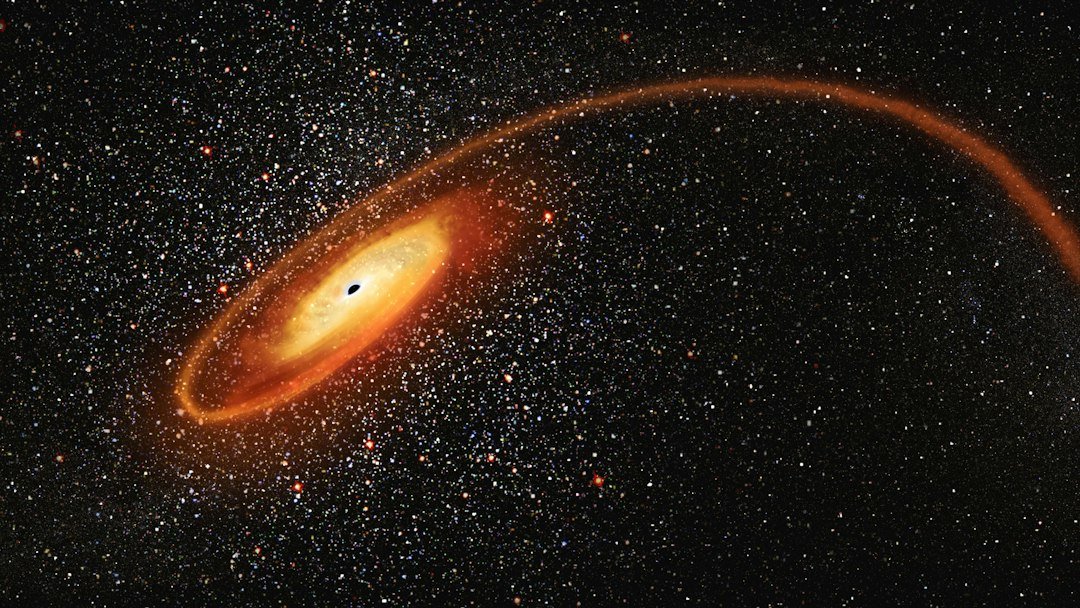
What happened: A Ministry of Science and Technology release on 23 October described research led by scientists at the Aryabhatta Research Institute of Observational Sciences (ARIES), an autonomous institute under the Department of Science and Technology. Researchers used numerical simulations of viscous matter flows around spinning black holes to study quasi-periodic oscillations (QPOs)—nearly regular variations in radiation from these systems.
The study focuses on how changes in the accretion flow and the black hole’s spin can affect the position and oscillation of a shock in the surrounding matter. The release says that, in the model, faster spin can move the shock closer to the black hole and produce a broader range of QPO frequencies. For a black hole about ten times the mass of the Sun, predicted frequencies in high-spin cases can exceed 100 hertz. That is a model result described by the researchers, not a universal measurement for every black hole.
Why it matters: Scientists study radiation from hot matter outside a black hole’s event horizon because light cannot escape from within it. Explaining rapid X-ray changes helps researchers interpret the extreme environments around these compact objects.
Exam link: know the terms accretion flow, accretion disc, event horizon, black-hole spin and QPO. Remember ARIES and the Department of Science and Technology. The release states that the research was published in the Journal of High Energy Astrophysics and involved collaborators in Poland and India.
Official source: PIB — research on black-hole spin and X-ray flickering, 23 October 2026. Publication: Journal of High Energy Astrophysics paper.
4. Enhanced NMMS app adds stronger attendance safeguards under VB-G RAM G
What happened: Rural Development Minister Shivraj Singh Chouhan launched an enhanced National Mobile Monitoring System (NMMS) app on 23 October. Developed with technical support from IIT Madras and other agencies, it strengthens attendance verification under VB-G RAM G.
The update adds device-level checks, secure transmission, anti-tampering safeguards, Google Play Integrity, liveness detection and refined AI face verification. The ministry also describes offline attendance and an exception mechanism so genuine workers are not penalised for network failures.
The same release reports nearly 46 crore person-days generated under VB-G RAM G and 10.997 crore Farmer IDs created, approaching the 11-crore milestone ahead of the December 2027 target. These are separate indicators and should not be confused: person-days measure employment generated, while Farmer IDs are a digital identification count.
Why it matters: Digital attendance can deter impersonation, but public programmes must also handle weak networks and device failures. The policy challenge is to maintain accountability without denying genuine workers access or wages.
Exam link: revise NMMS, digital attendance, liveness detection, IIT Madras and the difference between person-days and beneficiary identification figures. Questions may also test the ministry responsible for rural development programmes.
Official source: PIB — enhanced NMMS app, 23 October 2026.
5. FSDC reviews India’s financial stability risks
What happened: Finance Minister Nirmala Sitharaman chaired the 30th FSDC meeting in New Delhi on 23 October. The council discussed macro-financial stability amid geopolitical uncertainty, the AI boom and rising global bond yields, as well as domestic investment, capital flows and financial-sector reforms.
Why it matters: Financial stability concerns whether the system can continue providing payments, credit and savings services during shocks. Global yields, technology shifts and geopolitical events can affect funding costs, investor sentiment and asset prices.
The FSDC is a coordination forum involving financial-sector regulators and relevant government representatives. It is not a retail bank and does not set every individual institution’s operational rules. The release notes that the council called for heightened vigilance and more frequent meetings amid global uncertainty.
Exam link: revise FSDC’s full form, its coordination role and the difference between financial stability and day-to-day monetary policy. This is relevant to banking, insurance, economics and UPSC.
Official source: PIB — 30th FSDC meeting, 23 October 2026.
Quick revision table
| Topic | Fact to remember | Exam connection |
|---|---|---|
| STPI Dehradun | 30,000 sq ft; four floors | Startup ecosystem, MeitY |
| C-DAC–BOI MoU | Signed 22 October 2026 | Quantum-safe security, banking technology |
| Black-hole research | ARIES-led simulations; QPOs | Astrophysics, accretion flows |
| NMMS app | Enhanced security and liveness detection | Digital governance, rural employment |
| FSDC | 30th meeting chaired on 23 October | Financial stability, systemic risk |
Possible MCQ areas
- Which ministry oversees STPI and C-DAC?
- What does QPO stand for in black-hole research?
- Which organisation signed an MoU with C-DAC for financial-technology exploration?
- What is the role of liveness detection in digital attendance systems?
- Which council discussed macro-financial stability at its 30th meeting on 23 October 2026?
How to revise these updates
Memorise the organisation–ministry–location combinations, then revise the concepts behind each headline: incubation, post-quantum security, accretion flows and QPOs, digital attendance safeguards, and systemic financial risk. Confirm figures in the linked official releases; an announcement is not proof of a completed outcome.