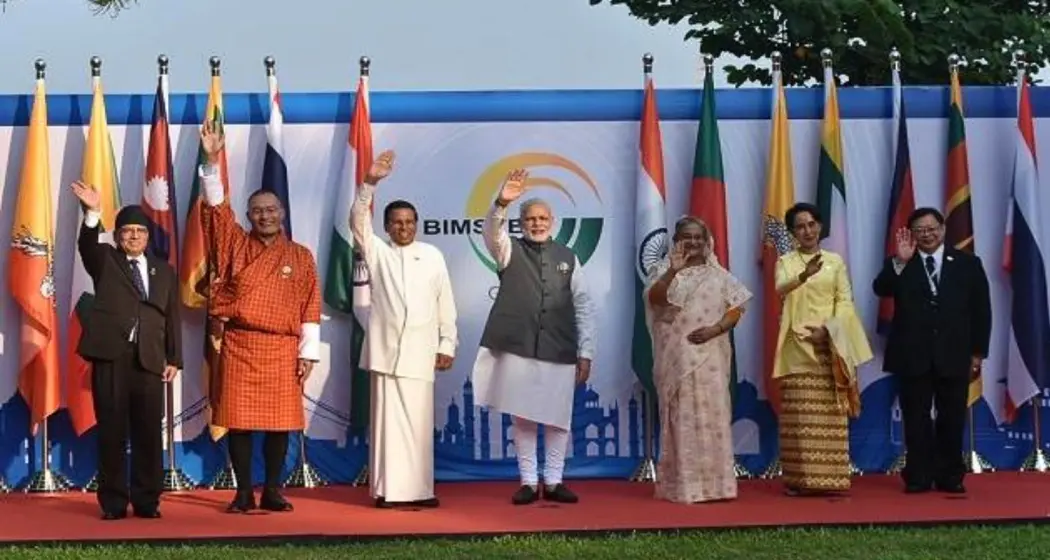
The 6th BIMSTEC Summit (2025) marked a significant milestone in regional cooperation, with India playing a pivotal role in shaping the agenda.
What is BIMSTEC?
BIMSTEC (Bay of Bengal Initiative for Multi-Sectoral Technical and Economic Cooperation) is a regional bloc of 7 nations:
South Asia: India, Bangladesh, Bhutan, Nepal, Sri Lanka
Southeast Asia: Myanmar, Thailand
Established: 1997 (Bangkok Declaration)
Headquarters: Dhaka, Bangladesh
Key Focus Areas: Trade, security, energy, connectivity, and cultural ties.
Key Outcomes of the 6th BIMSTEC Summit (2025)
| Aspect | Details |
|---|---|
| Theme | “BIMSTEC: Prosperous, Resilient, and Open” |
| Summit Declaration | Adoption of Bangkok Vision 2030 for regional prosperity. |
| Maritime Transport Agreement | Facilitates smoother trade and dispute resolution. |
| India’s Initiatives | – BIMSTEC Centres of Excellence (Disaster Management, Traditional Medicine, Agriculture) – BODHI Program (Skill development for youth) – BIMSTEC Chamber of Commerce & Annual Business Summit |
| Cultural & Sports Initiatives | – BIMSTEC Athletics Meet (2025) – First BIMSTEC Games (2027) – Young Leaders’ Summit & Hackathon |
| Security & Connectivity | – Strengthening counter-terrorism efforts – Kaladan Multi-Modal Project & Trilateral Highway |
Why is BIMSTEC Important for India?
Act East Policy: Bridges South Asia with Southeast Asia, countering China’s influence.
Economic Integration: Potential for a BIMSTEC Free Trade Agreement (FTA).
Alternative to SAARC: Bypasses Pakistan-led SAARC deadlock.
Strategic Projects:
BBIN Motor Vehicle Agreement (Bangladesh, Bhutan, India, Nepal)
BIMSTEC Energy Grid for cross-border power trade.
Security Cooperation: Joint military exercises (e.g., MILEX-18) and counter-terrorism efforts.
Challenges Facing BIMSTEC
Slow Implementation: Delays in FTA and connectivity projects.
Institutional Weakness: Lack of permanent secretariat and funding.
Geopolitical Tensions: Myanmar’s instability, India-China rivalry.
Previous BIMSTEC Summits (Key Highlights)
| Summit | Year | Key Outcomes |
|---|---|---|
| 1st | 2004 | Bangkok Declaration formalized BIMSTEC. |
| 2nd | 2008 | Proposal for BIMSTEC FTA. |
| 4th | 2018 | Adoption of BIMSTEC Charter. |
| 5th | 2022 | Formalized 7 cooperation pillars (e.g., Security led by India). |
BIMSTEC: Static GK You Should Know
BIMSTEC links South Asia and Southeast Asia around the Bay of Bengal. For competitive exams, revise the member countries, the organisation’s location of the secretariat, its cooperation areas and the chronology of major summits and the Charter. These facts often appear as matching, statement-based or chronology questions.
Key Revision Table
| Area | Revision Focus |
|---|---|
| Members | Seven Bay of Bengal countries |
| Cooperation | Security, trade, connectivity, environment and other sectoral areas |
| India’s role | Regional connectivity, maritime cooperation and economic integration |
Possible MCQs
Full form and member countries of BIMSTEC
Year of the BIMSTEC Charter
Location of the BIMSTEC Secretariat
Cooperation sectors and India’s assigned role
Date and Accuracy Note
Summit outcomes and cooperation structures can evolve. For a current-affairs question, use the latest official BIMSTEC or government release rather than relying only on a 2025 article.
How to Approach BIMSTEC Questions
BIMSTEC questions usually test factual combinations rather than a single isolated definition. Revise the seven member states together with the Bay of Bengal geographic context, the secretariat, the Charter, major summit years and cooperation areas. Then connect India’s role with regional connectivity, maritime cooperation and economic integration. A chronology table is particularly useful because summit questions can ask candidates to identify the correct sequence.
Related Current Affairs
Follow newer international-relations developments through the Current Affairs Hub and reinforce the topic with the Daily Quiz.