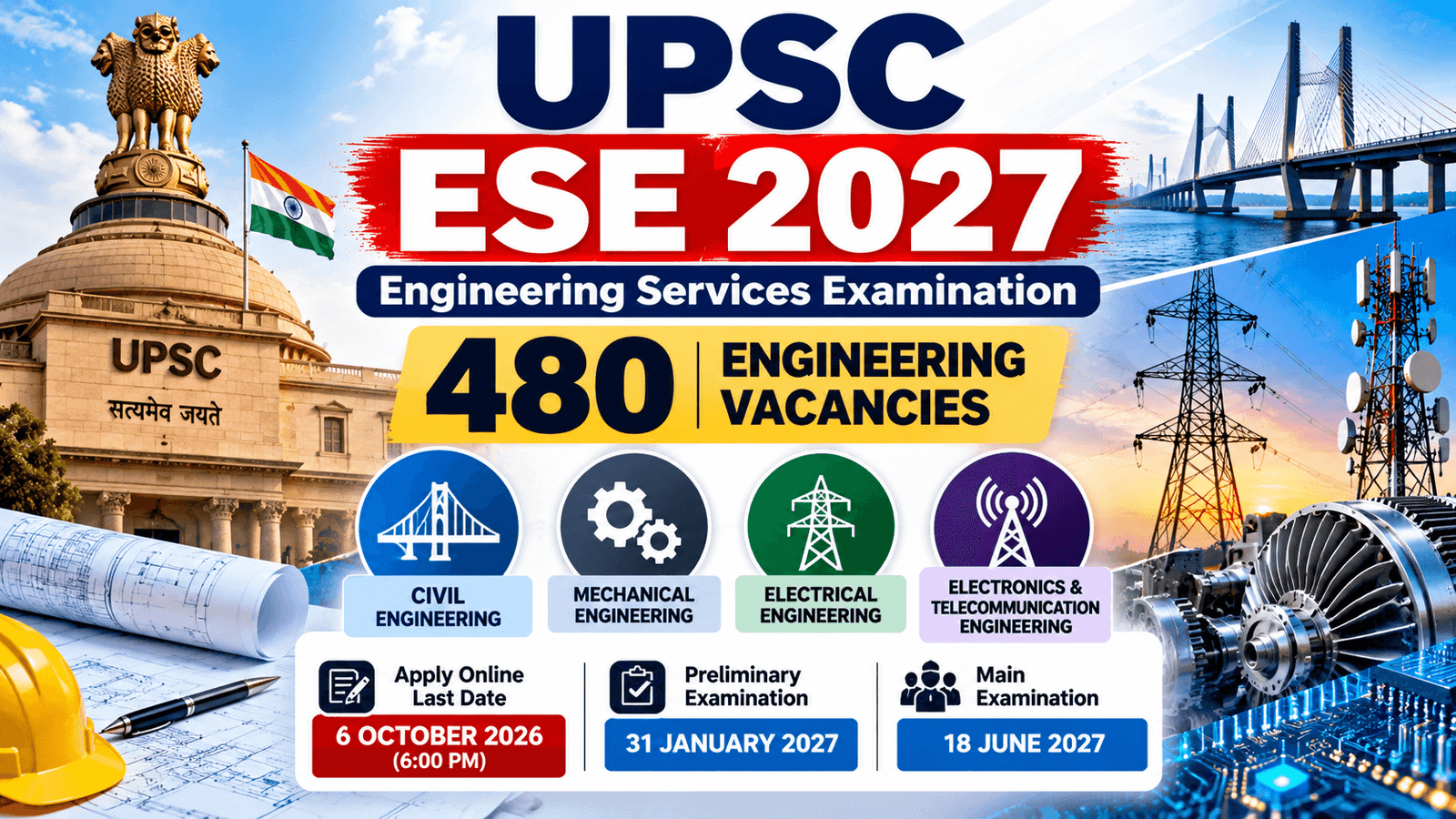
UPSC ESE 2027 Recruitment: 480 Engineering Vacancies, Apply by 6 October; Prelims on 31 January
The Union Public Service Commission (UPSC) Engineering Services Examination 2027 is at the application deadline stage today, 6 October 2026. Approximately 480 vacancies have been notified across four engineering disciplines. Candidates who meet the educational and other conditions should treat today as the final application day rather than waiting until the closing hour.
What has been announced?
UPSC issued the Engineering Services Examination 2027 notification on 16 September 2026. The examination is the principal UPSC route for recruitment to specified engineering services and posts in the Government of India. The four broad categories are Civil Engineering, Mechanical Engineering, Electrical Engineering, and Electronics & Telecommunication Engineering.
The vacancy figure is approximately 480 and is provisional. UPSC can revise vacancies according to requirements communicated by the participating services.
Why this recruitment matters
ESE is different from a general graduate recruitment examination because the selection is tied to a candidate’s engineering discipline. The recruitment pipeline is designed for technical services, so an applicant must check the exact engineering qualification and category requirements instead of treating the vacancy figure as a generic graduate opportunity.
Important dates
| Event | Date |
|---|---|
| Notification | 16 September 2026 |
| Application start | 16 September 2026 |
| Last date to apply | 6 October 2026, up to 6:00 PM |
| ESE Preliminary Examination | 31 January 2027 |
| ESE Main Examination | 18 June 2027 |
Vacancy and discipline structure
The recruitment covers four technical streams:
- Civil Engineering
- Mechanical Engineering
- Electrical Engineering
- Electronics & Telecommunication Engineering
The notification indicates around 19 vacancies for Persons with Benchmark Disabilities, subject to the detailed service-wise distribution and applicable rules. Candidates should use the official notification rather than secondary vacancy tables when checking a particular service.
Educational qualification
The core requirement is an engineering qualification in the relevant discipline, as prescribed in the UPSC notification. Candidates should not rely on the broad phrase “B.Tech/B.E.” alone. The acceptable qualification depends on the engineering category and the specific rules stated by UPSC.
Before final submission, verify the degree title, discipline, university recognition and any alternative qualification clauses in the official notice.
Age and eligibility checks
The examination has an age framework prescribed by UPSC, with the relevant cut-off date and category-based relaxations specified in the notification. The general age band is commonly centred on 21 to 30 years, but applicants should read the exact 2027 rules and applicable relaxations rather than relying on a generic age statement.
Nationality, educational qualification and other eligibility conditions should be checked independently. Meeting the age condition does not by itself establish eligibility for a particular engineering category.
Examination structure
The ESE selection process is built around three broad stages: Preliminary Examination, Main Examination and Personality Test.
The Preliminary Examination has two papers. The first covers General Studies and Engineering Aptitude and carries 200 marks. The discipline-specific paper carries 300 marks. The Main Examination then tests the candidate at a much deeper engineering level through conventional papers. Candidates who qualify the written stages proceed to the personality-test stage under the prescribed rules.
Application process: what to check today
- Use the official UPSC online application portal.
- Complete the required Universal Registration Number (URN) and common application information.
- Complete the examination-specific ESE application.
- Check the selected engineering discipline carefully.
- Complete live photo capture and upload the required photograph/signature information.
- Review every field before final submission.
- Submit before 6:00 PM on 6 October 2026 and retain the application number and URN.
A critical UPSC application rule
Candidates should take the final review seriously. UPSC has stated that the submitted examination application cannot simply be treated like an editable draft. Candidates should verify personal information, educational details, category information, examination centre preferences and uploaded material before submission.
Preparation relevance
For serious ESE candidates, the date sequence matters: application closes today, Prelims is scheduled for 31 January 2027 and Mains for 18 June 2027. That gives candidates a defined preparation runway. A practical strategy is to complete the application first, then divide preparation between the General Studies and Engineering Aptitude component and the technical discipline.
Who should not apply blindly?
Candidates whose degree does not match the prescribed engineering category should not assume that a related subject will automatically be accepted. Likewise, candidates relying on a provisional or incomplete qualification should read the notification’s exact qualification and document requirements before applying.
Understanding the 480-vacancy figure
The figure of approximately 480 should be read as a recruitment estimate rather than a guaranteed final number of appointments in every branch. UPSC examinations often carry provisional vacancy figures because participating departments communicate their requirements and those requirements can change. This matters when candidates compare ESE with a fixed-vacancy recruitment.
The four engineering categories are important because the competition is discipline-specific. A Civil Engineering candidate and an Electronics & Telecommunication Engineering candidate are not competing for one common technical paper. The technical paper and later service allocation are linked to the prescribed engineering category.
What the examination stages actually test
The Preliminary stage is not simply a screening test of engineering facts. Paper I covers General Studies and Engineering Aptitude, while Paper II tests the candidate’s engineering discipline. Candidates should therefore maintain two preparation tracks: one for common aptitude and general studies and another for the technical syllabus.
The Main examination changes the nature of preparation because conventional technical papers require candidates to present solutions rather than rely only on objective elimination. This makes answer-writing practice, numerical accuracy and time allocation important well before the Preliminary result.
Application-day risk checklist
- Do not confuse the URN with the examination-specific application number.
- Check the engineering discipline before final submission.
- Verify date of birth and category details against original documents.
- Confirm photograph, signature and live-photo requirements.
- Save the final submission confirmation and application number.
- Do not wait until the last hour when portal traffic may be high.
Planning after the application closes
The interval between the 6 October application deadline and the 31 January 2027 Preliminary Examination is finite. Candidates should convert it into a calendar immediately: complete a first technical-syllabus pass, revise General Studies and Engineering Aptitude continuously, then reserve the final phase for full-length papers and error analysis. The 18 June 2027 Main Examination date should also remain visible from the beginning; preparing only for Prelims without considering the conventional Main papers can create a second-stage bottleneck.
Official document hierarchy
For ESE, the UPSC examination notification and subsequent official notices override summaries published by coaching websites or job portals. Candidates should use secondary articles to understand the process, but use UPSC for the final decision on qualification, age, vacancy, centre, fee and application rules.
Official source
UPSC official website · UPSC online application portal · UPSC Active Examinations
Related resources
Government Jobs master page · Latest Articles · Admit Cards · Results
Bottom line: the important fact today is not merely “480 engineering posts.” The application window closes on 6 October 2026 at 6:00 PM, followed by the Preliminary Examination on 31 January 2027. Candidates should verify the discipline-specific eligibility and submit well before the final hour.