🔷 1. Introduction to Treasury Management
Treasury Management refers to the centralized function within a bank that manages its funds, liquidity, investments, and financial risks. It acts as the financial nerve center of a bank, ensuring optimal utilization of resources while maintaining regulatory compliance.
In modern banking, treasury is not limited to fund management—it also plays a key role in:
- Trading in financial markets
- Managing balance sheet risks
- Supporting profitability through arbitrage and hedging
🔷 2. Core Objectives of Treasury
🔹 1. Liquidity Management
Ensures that the bank has sufficient funds to meet:
- Withdrawal demands
- Loan disbursements
- Regulatory requirements
🔹 2. Profit Maximization
Treasury actively generates profits through:
- Trading in securities and forex
- Investment decisions
- Interest rate arbitrage
🔹 3. Risk Management
Manages key risks:
- Interest rate risk
- Foreign exchange risk
- Liquidity risk
🔹 4. Asset-Liability Management (ALM)
Balances:
- Cost of funds (liabilities)
- Returns on assets
🔹 5. Regulatory Compliance
Maintains:
- CRR (Cash Reserve Ratio)
- SLR (Statutory Liquidity Ratio)
🔷 3. Structure of Treasury
Treasury is divided into three specialized units:
🔹 (A) Front Office (Dealing Room)
Core Function: Execution of trades
Responsibilities:
- Buying and selling:
- Foreign exchange
- Government securities
- Money market instruments
- Managing proprietary positions
- Participating in auctions (e.g., government securities)
👉 This is the profit center of treasury.
🔹 (B) Mid Office (Risk Management Unit)
Core Function: Monitoring and control
Responsibilities:
- Setting exposure limits
- Monitoring stop-loss limits
- Measuring risk (VaR, duration, gap analysis)
- Providing MIS reports to management
👉 Acts independently to ensure checks and balances.
🔹 (C) Back Office (Operations & Settlement)
Core Function: Processing and accounting
Responsibilities:
- Trade confirmation and settlement
- Accounting entries
- Reconciliation of accounts
- Maintaining:
- Nostro accounts
- RBI accounts
- Demat accounts
👉 Ensures accuracy and regulatory compliance.
🔷 4. Treasury Products
Treasury deals with multiple financial instruments across markets:
🔹 (A) Foreign Exchange Market Instruments
- Spot transactions
- Forward contracts
- Futures
- Options
- Swaps
- Foreign currency loans
- Rediscounting of export/import bills
🔹 (B) Money Market Instruments
- Call/Notice/Term Money
- Treasury Bills
- Commercial Paper
- Certificate of Deposit
- Repo/Reverse Repo
- TREPS
🔹 (C) Capital/Securities Market Instruments
- Government securities
- Corporate bonds
- Debentures
- Equities
🔷 5. Foreign Exchange Market
🔹 Key Features
- Operates 24×7 globally
- Highly liquid market
- Transactions are electronic and instantaneous
- No geographical boundaries
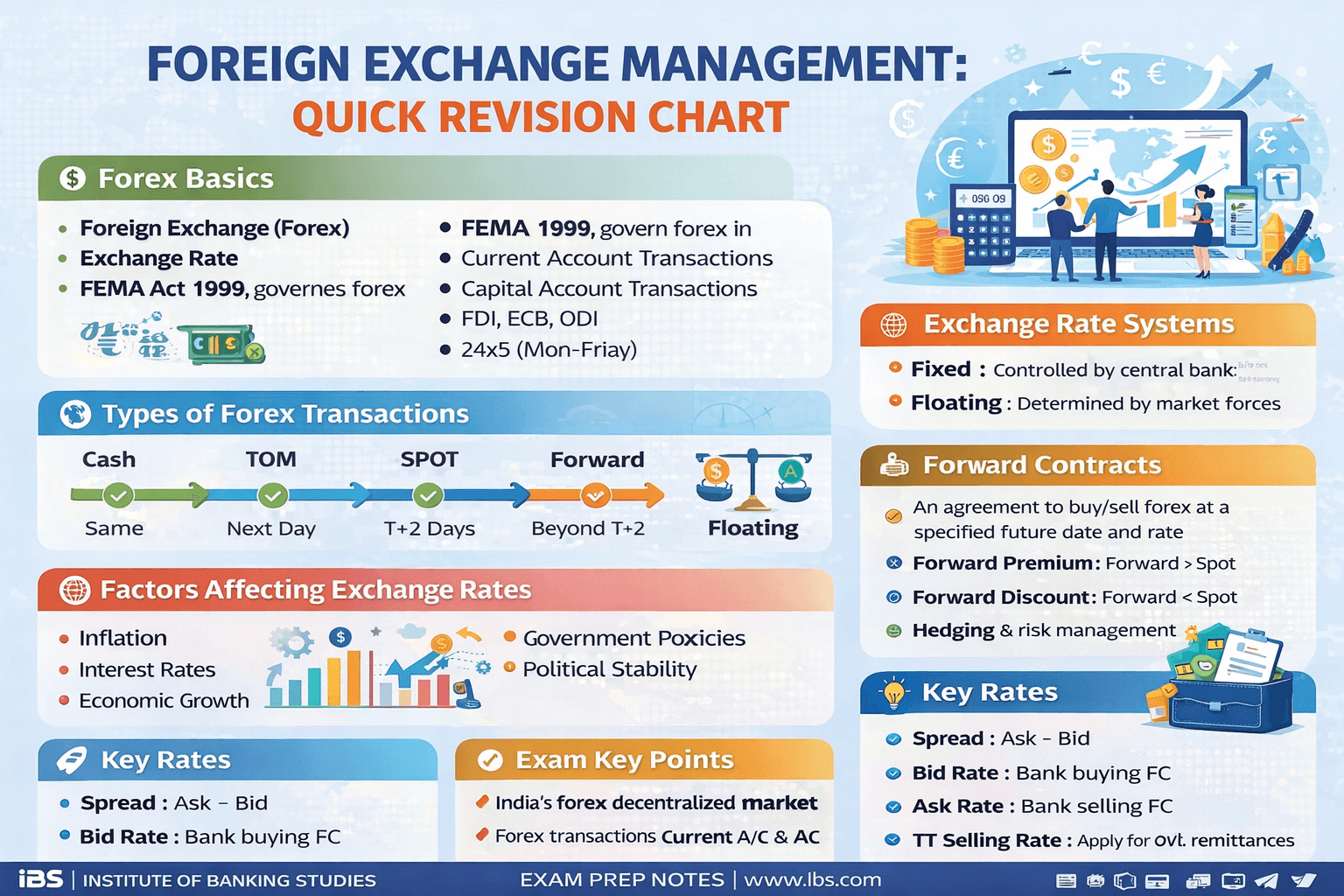
🔹 Types of Transactions
1. Spot Transactions
- Settlement in 2 working days
- Most common transaction
2. Cash (TOD)
- Same day settlement
3. TOM (Tomorrow)
- Next working day settlement
🔹 Forward Contracts
- Agreement to buy/sell currency at future date
- Used for hedging exchange rate risk
👉 Forward rates depend on interest rate differentials between currencies.
🔹 Derivative Instruments
✔ Futures
- Standardized contracts
- Traded on exchanges
- Require margin maintenance
✔ Options
- Right (not obligation) to buy/sell
- Types:
- Call option → Right to buy
- Put option → Right to sell
✔ Swaps
- Combination of two transactions
- Example:
- Spot + Forward
- Used for liquidity and risk management
🔷 6. Money Market
🔹 Definition
Market for short-term funds (maturity ≤ 1 year).
🔹 Call / Notice / Term Money
| Type | Duration | Nature |
|---|---|---|
| Call Money | Overnight | Unsecured |
| Notice Money | 2–14 days | Unsecured |
| Term Money | 15 days–1 year | Unsecured |
👉 Used for managing short-term liquidity mismatches.
🔹 Treasury Bills (T-Bills)
- Issued by Government
- Short-term instrument
- Issued at discount, redeemed at face value
Maturities:
- 91 days
- 182 days
- 364 days
🔹 Cash Management Bills (CMB)
- Ultra-short-term instruments
- Used by government to meet temporary cash mismatches
🔹 Commercial Paper (CP)
- Issued by corporates
- Unsecured instrument
- Requires high credit rating
- Higher yield than bank deposits
🔹 Certificate of Deposit (CD)
- Issued by banks
- Fixed maturity
- Tradable instrument
- No premature withdrawal
🔹 Repo and Reverse Repo
✔ Repo
- Banks borrow funds from RBI
- RBI provides liquidity
- Collateral: Government securities
✔ Reverse Repo
- Banks park surplus funds with RBI
- RBI absorbs liquidity
🔹 Liquidity Adjustment Facility (LAF)
Includes:
- Repo
- Reverse Repo
👉 Used by central bank to manage short-term liquidity.
🔹 Standing Deposit Facility (SDF)
- Absorbs liquidity without collateral
- Floor rate of interest corridor
🔹 Marginal Standing Facility (MSF)
- Emergency borrowing window
- Higher interest rate than repo
- Ceiling of interest corridor
🔹 TREPS (Triparty Repo)
- Collateralized borrowing/lending
- Third party acts as intermediary
- Eliminates counterparty risk
🔷 7. Securities Market
🔹 Government Securities (G-Secs)
- Issued by government
- Considered risk-free
- Used to meet SLR requirements
👉 Key Concept:
Bond price and yield are inversely related.
🔹 Investment Categories
| Category | Features |
|---|---|
| HTM | Held till maturity, no MTM |
| AFS | Marked to market |
| HFT | Frequent trading, MTM |
🔹 Corporate Debt
- Issued by companies
- Higher returns than G-Secs
- Higher risk
🔹 Bonds and Debentures
- Long-term instruments
- May be:
- Convertible
- Non-convertible
- Secured
- Unsecured
🔹 Equities
- Ownership in company
- Higher risk, higher return
- Regulated exposure limits for banks
🔷 8. International Treasury Operations
🔹 ADR (American Depository Receipts)
- Traded in US markets
- Represent shares of foreign companies
🔹 GDR (Global Depository Receipts)
- Traded in European markets
- Denominated in foreign currency
🔹 External Commercial Borrowings (ECB)
- Loans raised from foreign markets
- Used for expansion and capital expenditure
- Subject to regulatory limits
🔷 9. CRR and SLR
🔹 CRR (Cash Reserve Ratio)
- Portion of deposits kept with central bank
- Maintained in cash
🔹 SLR (Statutory Liquidity Ratio)
- Portion of deposits invested in:
- Cash
- Gold
- Government securities
🔹 Importance
- Ensures liquidity
- Controls inflation
- Maintains financial stability
🔷 10. Demand and Time Liabilities (DTL)
🔹 Demand Liabilities
- Savings account
- Current account
🔹 Time Liabilities
- Fixed deposits
- Recurring deposits
🔷 11. Risks in Treasury
🔹 1. Market Risk (Most Important)
- Interest rate fluctuations
- Price volatility
🔹 2. Credit Risk
- Default by counterparty
🔹 3. Liquidity Risk
- Inability to meet obligations
🔹 4. Operational Risk
- System failure
- Human error
🔷 12. Important Exam Concepts
- Arbitrage: Profit from price differences
- Spread: Difference between buying and selling price
- Open Position: Net exposure in forex
- Leverage: Using small capital for large exposure
🔷 13. High-Value Exam Points
- Repo injects liquidity; Reverse repo absorbs
- SDF = Floor rate; MSF = Ceiling rate
- TREPS replaced CBLO
- T-Bills issued at discount
- CP vs CD differences are frequently asked
- Front/Mid/Back office roles are very important