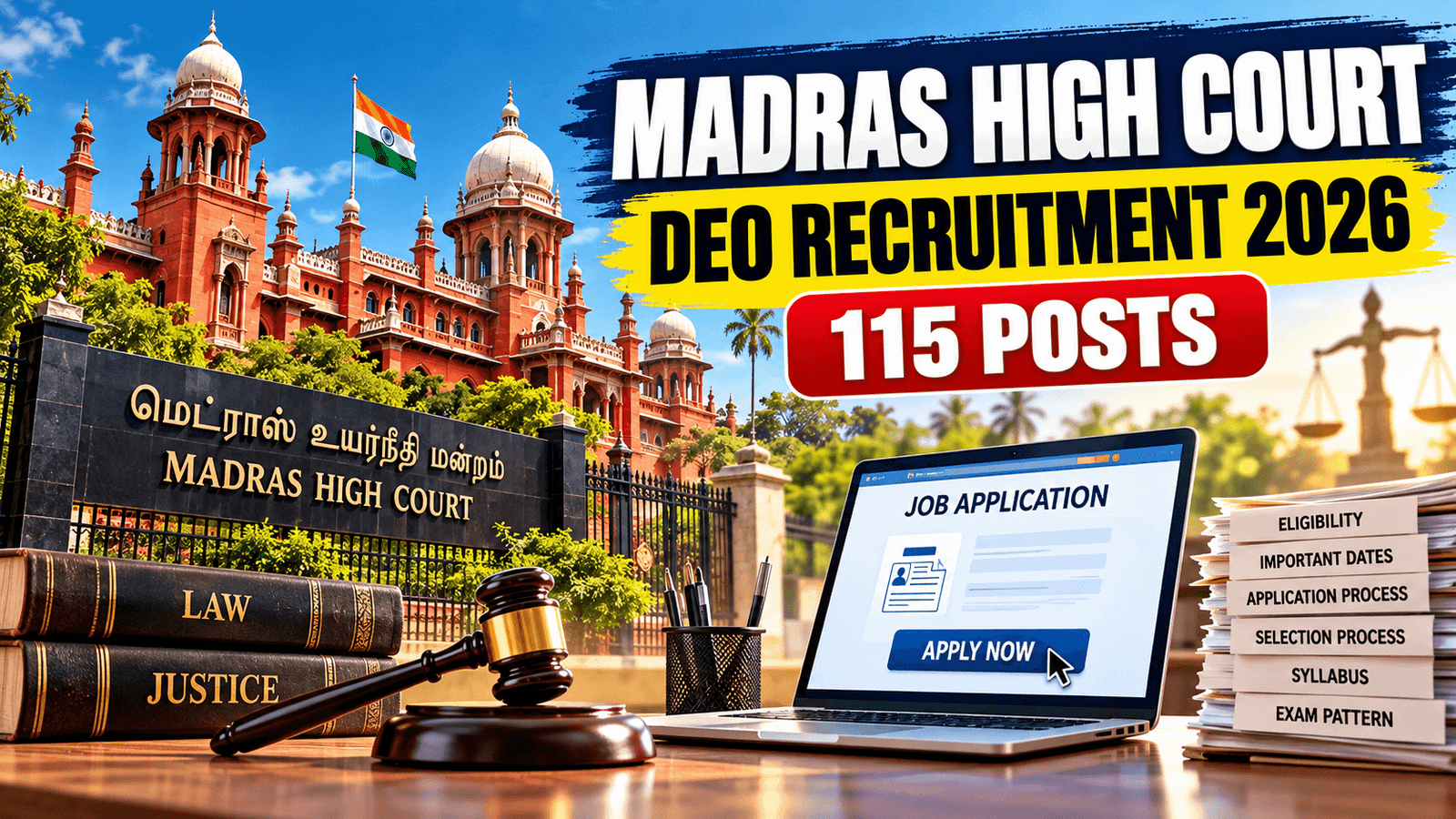
Madras High Court DEO Recruitment 2026 is a same-day deadline opportunity for candidates seeking Data Entry Operator work through e-Sewa Kendras at the Principal Seat and District Judiciary. The recruitment is being conducted through Notification No. 217/2026 dated 23 September 2026. The application window closes on 29 September 2026.
Madras High Court DEO Recruitment 2026: Key facts
| Particular | Details |
|---|---|
| Recruiting body | Madras High Court |
| Post | Data Entry Operator |
| Vacancies | 115 |
| Notification | No. 217/2026 |
| Notification date | 23 September 2026 |
| Application window | 23–29 September 2026 |
| Engagement | Contractual |
| Consolidated remuneration | ₹15,000 per month |
What is being recruited?
The notification covers 115 Data Entry Operator positions associated with e-Sewa Kendras at the Principal Seat of the Madras High Court and the District Judiciary. The work is therefore connected with court administration and digital service delivery rather than a generic clerical vacancy.
Why an e-Sewa Kendra role is different from a routine data-entry vacancy
An e-Sewa Kendra operates at the interface between citizens, court administration and digital services. That makes the recruitment relevant not only to job seekers but also to candidates studying the digitisation of public services and the Indian judicial system. The exact duties, qualifications and selection conditions, however, must be read from Notification No. 217/2026 rather than inferred from the job title.
Deadline-day document checklist
- Keep the prescribed educational qualification certificate ready.
- Check category or reservation documents, if applicable.
- Keep a valid identity document available for application-stage verification.
- Use a working mobile number and email address that can be accessed after submission.
- Review uploaded photographs, signatures and certificates against the portal specifications.
- Save the final acknowledgement and application details immediately after submission.
How to prepare without inventing an exam pattern
One common mistake in recruitment coverage is to copy an assumed selection pattern from another Data Entry Operator vacancy. That can mislead applicants. Candidates should first establish the actual selection stages in the Madras High Court notification. If a typing, computer or written assessment is specified, preparation should then be based on that prescribed stage. Until then, the safest preparation is to understand the notification, organise documents and monitor the official court website for subsequent notices.
Why the deadline matters
The application window runs from 23 September through 29 September 2026. Candidates should complete the process within the time specified by the official recruitment portal rather than assuming that a last-day extension will be announced. The official notification remains the controlling document for eligibility, documents, selection procedure and other conditions.
Application checklist
- Read Notification No. 217/2026 in full.
- Confirm that your educational and technical qualifications satisfy the DEO conditions.
- Keep identity, educational and category documents ready in the prescribed form.
- Enter name, date of birth, category, mobile number and email exactly as required.
- Check uploaded documents for clarity and prescribed size/format.
- Complete the online application before the closing time stated by the portal.
- Save the final application, acknowledgement and any submission/payment proof.
Selection and exam relevance
The selection mechanism should be taken directly from the official notification. Candidates should not assume that every government recruitment follows the SSC or banking model of a computer-based written examination followed by a skill test. The notification determines whether and how written, technical, typing or other stages apply.
Static GK: Madras High Court
The Madras High Court is the High Court for Tamil Nadu and also has jurisdiction over the Union Territory of Puducherry. Its principal seat is in Chennai. This recruitment therefore provides a useful bridge between current recruitment awareness and Indian Polity.
- Article 214 provides for High Courts for States, subject to constitutional provisions for common High Courts.
- Article 226 deals with the writ jurisdiction of High Courts.
- Article 227 deals with the High Court’s power of superintendence over subordinate courts and tribunals.
- High Courts are constitutional courts and form a key part of India’s judicial structure.
Possible MCQ areas
- Which institution issued Notification No. 217/2026?
- How many DEO posts are advertised?
- What is the final application date?
- What is the consolidated monthly remuneration?
- Where is the principal seat of the Madras High Court?
- Which Union Territory falls within its jurisdiction?
- Which Article gives High Courts writ jurisdiction?
- Which Article deals with High Court superintendence?
Official source
Madras High Court – Official Website