National Developments
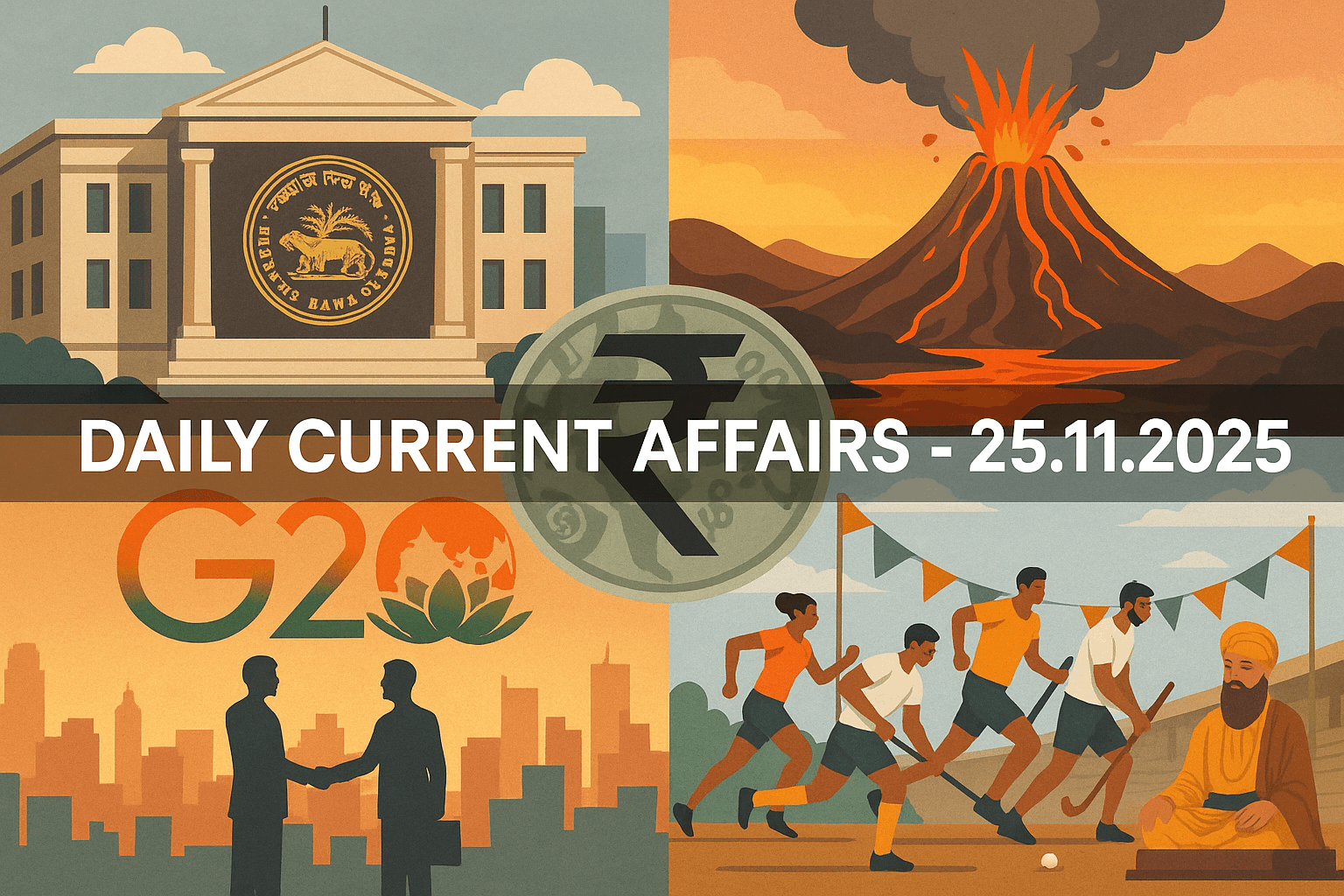
The Reserve Bank of India (RBI) in its November 2025 “State of the Economy” report stated that India is poised to enter a virtuous investment-cycle, driven by increasing investment flows, stronger productivity and resilient growth, despite global headwinds.
The RBI also issued a cautionary note that global financial markets are showing ‘heightened exuberance’, warning of potential over-valuation risks even as domestic economic indicators remain favourable.
The rupee came under pressure, nearing the ₹ 90 per USD mark, prompting the RBI to intervene via dollar sales in the inter-bank and non‐deliverable forward markets to stabilise the currency.
India’s factories and service sectors recorded sharper activity in October, helped by festival demand and GST relief measures; consumer price inflation moderated significantly, giving the central bank room to consider rate cuts.
On the legislative front, the Chandigarh Bill proposed by the Union Home Ministry will not be introduced in the forthcoming Winter Session of Parliament, after consultations with stakeholders; the government affirmed it does not seek to alter the current arrangements between Chandigarh, Punjab and Haryana.
United Nations Human Rights Office (UN OHCHR) experts expressed concern over India’s counter-terrorism operations in Jammu & Kashmir, asserting that some practices may violate human rights norms — a development to watch in the context of internal security and foreign policy.
International Affairs
At the G20 Johannesburg Summit (22-23 November 2025), leaders adopted a 122-point declaration stressing “Solidarity, Equality, Sustainability”. Key themes included climate finance, value-chains in Africa, debt relief for developing nations, digital transformation and multilateral reform.
The United States and Ukraine made fresh breakthroughs in talks around the 28-point peace plan proposed by Donald Trump, reflecting renewed momentum in conflict resolution after months of stagnation.
In a major international development, Ethiopia’s Hayli Gubbi volcano erupted for the first time in some 10,000 years. The eruption could influence global aviation, local humanitarian responses and environmental risk assessments.
Japan is executing a strategic pivot: converting Hokkaido — traditionally a dairy hub — into a semiconductor manufacturing hub, as part of its bid to re-enter the global tech race and diversify beyond resource-dependent industries.
Global banks are significantly increasing their investments into India’s financial sector, as regulatory relaxations and growth prospects make Indian banks more appealing. Foreign deals in India’s banking sector have already crossed the US $8 billion mark in 2025 to date.
Banking & Finance Focus (For Competitive Exams)
The RBI’s remarks on a nascent investment cycle are pivotal for exam-candidates: they signal potential policy moves, credit-flow expansion, and banking sector growth.
The rupee’s slide and the RBI’s intervention highlight the central bank’s dual role – inflation management plus currency/international reserve stability.
India’s foreign exchange reserves remain ample, providing a cushion against external shocks; key for banking and finance questions.
The foreign bank-investment surge into India’s banking sector signals regulatory shifts (such as possible relaxation of foreign share-holding caps) and evolving industry structure – a useful topic for “Banking Awareness” sections.
Inflation recently hit historic lows, which may influence future monetary policy (possible rate cuts), credit-flow to banks, and NPAs.
The decision not to introduce the Chandigarh Bill shows how governance issues and federal-centre arrangements continue to interplay with finance and development.
Sports & Events
The Khelo India University Games 2025 kicked off in Jaipur on 24 November 2025, with cultural performances marking the opening ceremony. (Tie-up with youth, sports policy, national development).
The celebration of the 350th Martyrdom Anniversary of Guru Tegh Bahadur on 25 November will lead to state-level holidays in Uttar Pradesh, Punjab, Haryana and Delhi; this has relevance for general-awareness (holiday lists) and socio-cultural context.
Miscellaneous & Quick Facts
Low headline inflation (now below 0.5% in some months) may alter banking credit cost and deposit strategies.
Manufacturing PMI readings have hit above 59, showing a revival of industrial activity and bank credit demand.
Global trade uncertainties persist (eg: US tariffs on Indian goods), which may affect export-oriented sectors and trade-finance businesses in banking.
The theme of investments flowing into India’s financial sector means both opportunities and heightened regulatory risk – relevant for banking-sector MCQs.