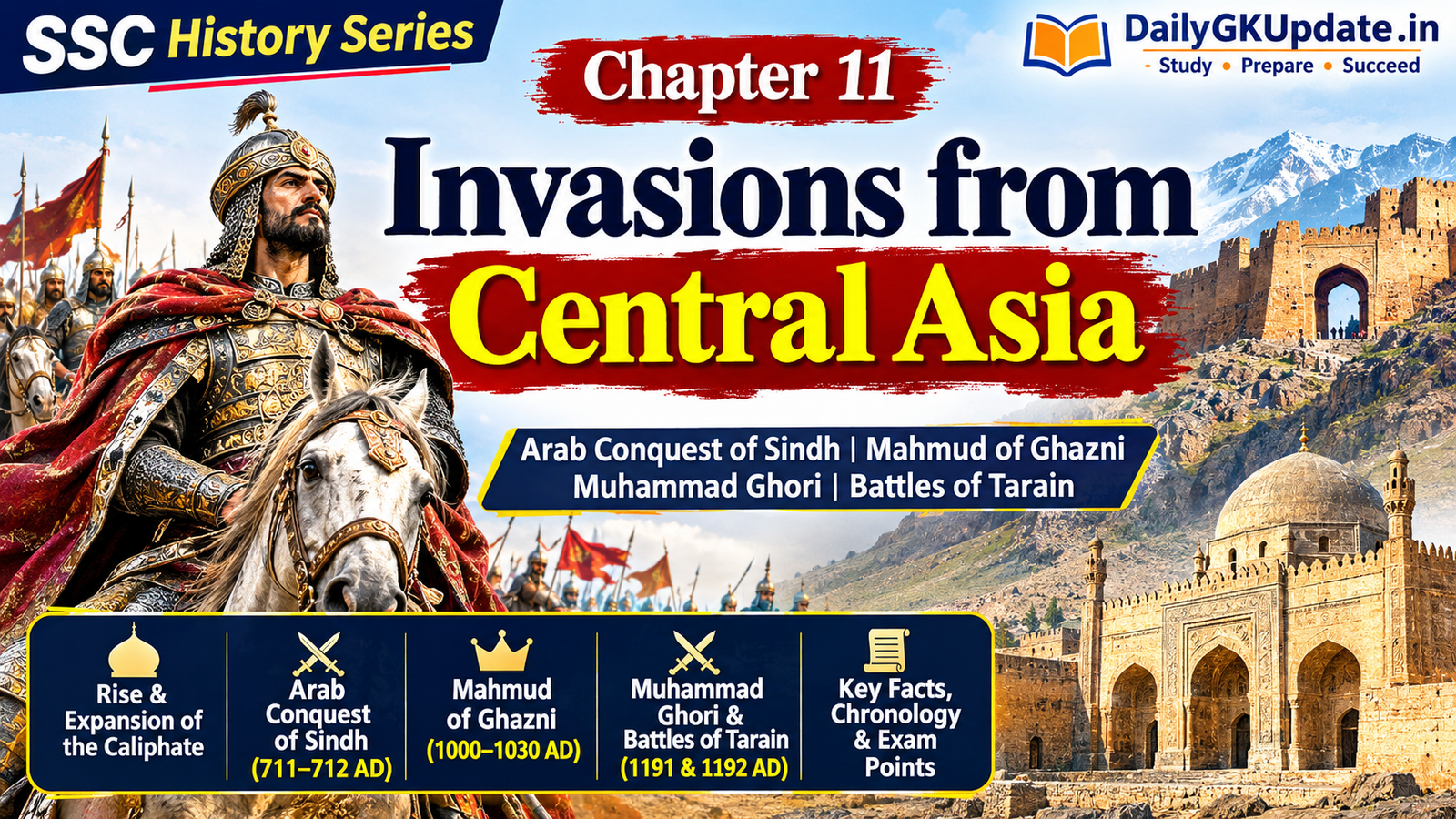
Invasions from Central Asia – SSC History Chapter 11
Chapter 11 – History for SSC: The invasions from Central Asia transformed the political landscape of north-western and northern India between the eighth and early thirteenth centuries. This chapter explains the Arab conquest of Sindh under Muhammad bin Qasim, the rise of the Ghaznavids, Mahmud of Ghazni’s campaigns, the Ghurid expansion under Muhammad Ghori, and the battles that paved the way for the Delhi Sultanate. It also examines the historical significance of these events and separates established facts from traditional textbook claims that require qualification.
Learning objectives
- Understand the expansion of the Umayyad Caliphate and the Arab conquest of Sindh.
- Identify the roles of Al-Hajjaj, Muhammad bin Qasim and Raja Dahir.
- Trace the rise of the Ghaznavids from Alptigin and Sabuktigin to Mahmud of Ghazni.
- Recall Mahmud’s important campaigns, Somnath raid, and association with Al-Biruni and Firdausi.
- Explain Muhammad Ghori’s campaigns and the First and Second Battles of Tarain.
- Connect the Battles of Tarain and Chandawar with the establishment of Turkish political power in north India.
1. Historical background: West and Central Asia
The seventh century witnessed the rise of Islam in Arabia and the rapid expansion of the early Islamic state beyond the Arabian Peninsula. Under the Rashidun and Umayyad caliphs, Arab armies moved through West Asia, North Africa and parts of Central Asia. The Umayyad Caliphate (661–750 CE), whose capital was Damascus, extended its authority towards the eastern frontier, bringing the regions around Makran and the lower Indus into the orbit of its expansion.
By the ninth and tenth centuries, the political authority of the Abbasid Caliphate had weakened in many provinces. Governors, military commanders and regional dynasties increasingly exercised independent power while continuing, in some cases, to recognise the caliph symbolically. Persian-speaking administrators and Turkish military commanders became influential in several Islamic states. These developments formed the wider background to the emergence of the Ghaznavids and Ghurids.
2. Arab conquest of Sindh
2.1 Causes and immediate context
Arab merchants had maintained commercial links with the western coast of the Indian subcontinent long before the conquest of Sindh. The region was strategically important because it connected the Iranian plateau, Makran, the lower Indus and maritime routes across the Arabian Sea. The Umayyad state also sought to secure its eastern frontier and extend its political influence.
Medieval accounts associate the expedition with the seizure of ships carrying passengers, including women and children, and with disputes over the protection of shipping. The precise details and responsibility for the incident differ across accounts; it should therefore be treated as the immediate explanation preserved in the chronicles, not as the sole cause. Frontier security, political expansion and control of routes were also important factors.
2.2 Muhammad bin Qasim and Raja Dahir
In 711–712 CE, the Umayyad governor of Iraq, Al-Hajjaj ibn Yusuf, organised an expedition to Sindh under the command of his young relative Muhammad bin Qasim. The ruler of Sindh was Raja Dahir, whose capital and power centres lay in the lower Indus region. Muhammad bin Qasim first captured Debal, an important port, and then advanced through other towns and strongholds in Sindh.
Raja Dahir was defeated and killed in the campaign, commonly dated to 712 CE. Arab forces subsequently occupied important centres including Brahmanabad and Alor, and extended their control towards Multan. The conquest was not an effortless or instantaneous occupation of the entire subcontinent: it was a regional conquest focused on Sindh and parts of the lower Indus frontier.
2.3 Administration and historical significance
The Arab administration relied on military garrisons, local intermediaries and existing revenue arrangements. In some places, local communities and officials continued to perform administrative functions under the new authority. Policies varied according to locality and political circumstances. The textbook also records that Muhammad bin Qasim advanced to Multan, that Mansura developed as an important Arab centre in Sindh, and that Arabic and Sindhi were both used in the region. It describes periods of accommodation and friendly relations between Hindu and Muslim communities under rulers who accepted local social and administrative realities. The textbook narrative also refers to the burning of premises by members of Dahir’s royal household, including the queen and royal relatives, during the conquest. It mentions enslavement of a large number of captives and the recruitment of able-bodied men for military service; these claims should be understood as accounts of coercion preserved in conquest narratives, rather than as neutral population statistics. It further describes the rule of Qasim and his successors, the establishment of Mansura, and the eventual decline of this early Arab political authority for several reasons. These developments should be understood alongside the violence, displacement and coercion that accompanied conquest; experiences differed across communities and localities. Arabic and Persian sources, as well as the later Persian narrative known as the Chachnama, preserve accounts of the conquest and its aftermath.
The Chachnama is especially important but must be read critically: the surviving Persian work was composed by Ali Kufi in the thirteenth century, several centuries after the conquest, and presents a narrative of earlier events. The Arab conquest created a lasting Muslim-ruled region in Sindh and opened channels of contact in trade, scholarship and culture. However, Arab rule did not immediately extend across northern India. The conquest of Sindh was therefore significant, but it should not be confused with the later establishment of the Delhi Sultanate.
3. Rise of the Ghaznavids
3.1 Alptigin and Sabuktigin
The Ghaznavid dynasty emerged from the world of the Samanid state in Central Asia and eastern Iran. Alptigin, a Turkish military commander associated with the Samanid administration, established himself at Ghazni (in present-day Afghanistan) around 962 CE after a struggle at the Samanid court. His successors continued to govern the region, initially acknowledging Samanid overlordship.
Sabuktigin, another Turkish military commander who succeeded to power at Ghazni, strengthened the principality and laid the foundations of an independent dynasty. He ruled until 997 CE. His campaigns brought him into conflict with the Hindu Shahi rulers controlling parts of the Kabul–Peshawar frontier. His son Mahmud succeeded after a contest with his brother and established himself as the dominant ruler in 998 CE.
3.2 Mahmud of Ghazni (998–1030 CE)
Mahmud expanded the Ghaznavid state across Khorasan, Afghanistan and north-western India. He received titles from the Abbasid caliph, including Yamin al-Dawla. Ghazni became a major political and cultural centre. His military power rested substantially on a professional army with important Turkish elements, and his campaigns extended both westwards into Iran and eastwards into the Indian subcontinent.
4. Mahmud of Ghazni’s campaigns in India
Mahmud conducted repeated campaigns across the north-western frontier and the northern plains. Textbooks commonly state that he made 17 raids into India, generally placing them between 1000 and 1027 CE. The exact count and classification of individual expeditions vary among historical accounts. His objectives included acquiring wealth, securing strategic routes, weakening rival powers, and strengthening the resources and prestige of his empire. It is inaccurate to reduce every campaign to a single motive or to assume that he sought to annex all of India.
4.1 Important campaigns and events
- 1001 CE – Battle near Peshawar/Waihind region: Mahmud defeated the Hindu Shahi ruler Jayapala. Jayapala later died, and his son Anandapala continued resistance.
- 1008–1009 CE – Conflict with Anandapala: Mahmud defeated a confederacy associated with Anandapala in the north-west. This strengthened Ghaznavid influence in the Punjab frontier.
- Thanesar: Mahmud raided the important religious and political centre of Thanesar during his campaigns in the early eleventh century.
- 1018–1019 CE – Mathura and Kannauj: His forces advanced into the Ganga-Yamuna region, attacking major urban and religious centres, including Mathura and Kannauj.
- 1025–1026 CE – Somnath: Mahmud undertook his best-known campaign against the celebrated temple at Somnath in the Kathiawar peninsula of present-day Gujarat. The shrine was plundered and the expedition brought substantial wealth to Ghazni. Later narratives differ in detail and sometimes exaggerate aspects of the event.
- 1027 CE – Campaign against the Jats: A later expedition is commonly associated with the Jats of the lower Indus region.
4.2 Was Mahmud interested in establishing an empire in India?
Mahmud did not attempt to establish a single empire over the whole Indian subcontinent. His campaigns were characterised by repeated military expeditions, extraction of wealth, strategic control and the imposition of tribute in some regions. The Punjab, however, became an important part of the Ghaznavid dominions. This territorial foothold distinguished the Ghaznavid presence from a series of raids alone and gave later rulers a base from which to intervene in north Indian politics.
4.3 Al-Biruni and Firdausi
Al-Biruni (Abu Rayhan al-Biruni) was a distinguished scholar of Central Asian origin who studied Indian religion, philosophy, mathematics, astronomy and society. His celebrated work on India is commonly known as Kitab al-Hind (also referred to by its longer Arabic title). He learned Sanskrit and engaged with Indian intellectual traditions. His work is a major source for understanding how a learned observer from the Islamic world studied India in the early eleventh century.
Firdausi was the Persian poet who composed the epic Shahnameh (Book of Kings), a landmark of Persian literature. He is associated with Mahmud’s age, although the traditional story of his relationship with the ruler is complex and should not be reduced to a simple claim that he served as a court poet throughout Mahmud’s reign.
4.4 Death and legacy
Mahmud died in 1030 CE. His successor was his son Masud I. The Ghaznavid state continued for generations, although its western territories were increasingly challenged by other Central Asian powers. Its later political centre of gravity shifted towards Afghanistan and the Punjab.
5. Rise of the Ghurids and Muhammad Ghori
Ghur (or Ghor) was a mountainous region in present-day central Afghanistan. The Ghurid rulers gradually emerged as a major power and challenged the Ghaznavids. Muhammad of Ghor, commonly called Muhammad Ghori in Indian history textbooks, was one of the principal figures in the Ghurid expansion into the Indian subcontinent. Unlike Mahmud, whose Indian campaigns were often raids supported by control of the Punjab, Muhammad Ghori pursued a more sustained programme of territorial conquest and political consolidation.
5.1 Early campaigns
- 1175 CE: Muhammad Ghori captured Multan and advanced into the lower Indus region.
- 1178 CE: His expedition into Gujarat was defeated by the forces of the Chaulukya (Solanki) kingdom. The battle is commonly associated with the Gujarat ruler Mularaja II and the regency of his mother Naikidevi. The defeat encouraged Ghori to adopt a different route and strategy for expansion.
- 1186 CE: Muhammad Ghori captured Lahore and ended the remaining Ghaznavid rule under Khusrau Malik. This removed a major rival and strengthened the Ghurid position in the Punjab.
6. Battles of Tarain
6.1 First Battle of Tarain (1191 CE)
Tarain (also written Taraori), near present-day Thanesar in Haryana, became the site of a decisive confrontation between Muhammad Ghori and Prithviraj Chauhan, the Chahamana ruler associated with Ajmer and Delhi. After Ghori captured the strategically important fort of Tabarhinda (often identified with Bhatinda), Prithviraj advanced against him. In the First Battle of Tarain in 1191 CE, the forces of Prithviraj defeated Ghori. Ghori was wounded and withdrew towards the north-west.
6.2 Second Battle of Tarain (1192 CE)
Muhammad Ghori returned the following year with a reorganised force. The Second Battle of Tarain, fought in 1192 CE, ended in a decisive Ghurid victory. Prithviraj Chauhan was defeated, and Ghurid influence expanded across important parts of north India. The battle is regarded as a major turning point because it weakened the Chahamana power and opened the route towards the upper Gangetic plain.
The outcome should not be explained by a simplistic claim that one side lacked courage or that all Rajput rulers were united or disunited in the same way. Military organisation, command structure, mobility, tactics, political rivalries and the ability to sustain campaigns all mattered. The political landscape was diverse, and different regional powers responded to the Ghurid advance in different ways.
7. Battle of Chandawar (1194 CE)
After Tarain, Muhammad Ghori turned towards the Ganga valley. In 1194 CE, his forces fought Jayachandra (Jaichand), the Gahadavala ruler of Kannauj, at Chandawar, generally identified near the Yamuna in present-day Uttar Pradesh. Jayachandra was defeated and killed. The victory weakened Gahadavala power and facilitated further Ghurid expansion in the Ganga-Yamuna region.
8. Muhammad Ghori’s death and the foundation of the Delhi Sultanate
Muhammad Ghori was assassinated in 1206 CE while returning through the north-western region. The circumstances and identity of his assassins are described differently in historical traditions. He left no son to inherit his empire. His former military commanders and governors assumed authority in different regions. In north India, Qutb al-Din Aibak, who had governed the Ghurid territories, established an independent rule at Delhi in 1206 CE. This marks the conventional beginning of the Mamluk or Slave dynasty of the Delhi Sultanate. Iltutmish later consolidated the Sultanate and made it a more stable political institution.
9. Mahmud of Ghazni and Muhammad Ghori: comparison
| Basis | Mahmud of Ghazni | Muhammad Ghori |
|---|---|---|
| Dynasty | Ghaznavid | Ghurid |
| Period | 998–1030 CE | Major Indian campaigns from 1175 CE; died 1206 CE |
| Political base | Ghazni; later controlled Punjab | Ghur and Ghurid territories; captured Lahore in 1186 CE |
| Indian strategy | Repeated raids, extraction of wealth and frontier expansion | Sustained campaigns aimed at territorial control and political consolidation |
| Key association | Somnath campaign, 1025–1026 CE | Second Battle of Tarain, 1192 CE |
| Historical consequence | Ghaznavid control of Punjab became a frontier base | Ghurid conquests enabled the establishment of the Delhi Sultanate by Aibak in 1206 CE |
10. Chronology: important dates at a glance
| Year | Event |
|---|---|
| 661 CE | Beginning of the Umayyad Caliphate |
| 711–712 CE | Muhammad bin Qasim’s conquest of Sindh |
| c. 962 CE | Alptigin establishes his position at Ghazni |
| 997 CE | Death of Sabuktigin |
| 998 CE | Mahmud establishes his rule at Ghazni |
| 1001 CE | Mahmud defeats Jayapala |
| 1008–1009 CE | Conflict with Anandapala |
| 1018–1019 CE | Campaigns against Mathura and Kannauj |
| 1025–1026 CE | Somnath campaign |
| 1030 CE | Death of Mahmud of Ghazni |
| 1175 CE | Muhammad Ghori captures Multan |
| 1178 CE | Ghurid defeat in Gujarat |
| 1186 CE | Capture of Lahore; end of Ghaznavid rule there |
| 1191 CE | First Battle of Tarain |
| 1192 CE | Second Battle of Tarain |
| 1194 CE | Battle of Chandawar |
| 1206 CE | Death of Muhammad Ghori; Aibak establishes independent rule in north India |
11. Why these invasions matter in Indian history
The Arab conquest of Sindh connected the lower Indus region more closely with the political and commercial networks of the Islamic world, but its immediate territorial reach remained limited. The Ghaznavid campaigns brought repeated military pressure on north-western India and established a durable base in the Punjab. The Ghurid conquests, particularly after the Second Battle of Tarain and the Battle of Chandawar, created conditions for a new political order in north India.
These developments did not occur in an empty political landscape. Indian regional kingdoms continued to govern large territories, negotiate alliances, fight wars and patronise religious and cultural institutions. For the regional political setting immediately before these invasions, see Chapter 10: Early Medieval India. The transition to the Delhi Sultanate was a process involving military conquest, local political negotiation, administrative adaptation and the activities of commanders such as Aibak and Iltutmish.
12. SSC examination focus: facts to remember
- Arab conquest of Sindh: Muhammad bin Qasim; governor Al-Hajjaj; ruler Raja Dahir; Debal; 711–712 CE.
- Chachnama: Persian narrative associated with Ali Kufi, composed in the thirteenth century.
- Ghaznavid origins: Alptigin, Sabuktigin and Mahmud; capital at Ghazni.
- Mahmud of Ghazni: reign 998–1030 CE; Jayapala (1001); Anandapala (1008–1009); Somnath (1025–1026).
- Al-Biruni: Kitab al-Hind; Firdausi: Shahnameh.
- Muhammad Ghori: Multan (1175), Gujarat defeat (1178), Lahore (1186), Tarain (1191 and 1192), Chandawar (1194).
- Delhi Sultanate: conventional beginning in 1206 CE under Qutb al-Din Aibak.
13. Practice MCQs
- Who led the Umayyad expedition that conquered Sindh in the early eighth century?
A. Mahmud of Ghazni
B. Muhammad bin Qasim
C. Muhammad Ghori
D. Qutb al-Din Aibak
Answer: B. Muhammad bin Qasim. The expedition was organised under the authority of Al-Hajjaj ibn Yusuf. - Who was the ruler of Sindh defeated during Muhammad bin Qasim’s campaign?
A. Jayapala
B. Anandapala
C. Raja Dahir
D. Prithviraj Chauhan
Answer: C. Raja Dahir. - Who laid the foundations of Ghaznavid power at Ghazni before Mahmud?
A. Alptigin and Sabuktigin
B. Iltutmish and Aibak
C. Balban and Razia
D. Alp Arslan and Malik Shah
Answer: A. Alptigin and Sabuktigin. - Mahmud of Ghazni’s famous campaign against Somnath took place in:
A. 1001 CE
B. 1018 CE
C. 1025–1026 CE
D. 1192 CE
Answer: C. 1025–1026 CE. - Who wrote the Kitab al-Hind?
A. Firdausi
B. Al-Biruni
C. Minhaj-us-Siraj
D. Ziauddin Barani
Answer: B. Al-Biruni. - The Shahnameh is associated with:
A. Firdausi
B. Kalhana
C. Banabhatta
D. Amir Khusrau
Answer: A. Firdausi. - The First Battle of Tarain was fought in:
A. 1178 CE
B. 1186 CE
C. 1191 CE
D. 1194 CE
Answer: C. 1191 CE. - Who defeated Prithviraj Chauhan in the Second Battle of Tarain?
A. Mahmud of Ghazni
B. Muhammad Ghori
C. Sabuktigin
D. Qutb al-Din Aibak
Answer: B. Muhammad Ghori. - The Battle of Chandawar (1194 CE) was fought against which ruler?
A. Jayachandra
B. Jayapala
C. Raja Dahir
D. Mularaja II
Answer: A. Jayachandra. - Who established independent rule in north India after Muhammad Ghori’s death in 1206 CE?
A. Iltutmish
B. Balban
C. Qutb al-Din Aibak
D. Razia Sultan
Answer: C. Qutb al-Din Aibak.
14. Quick revision summary
- The Arab conquest of Sindh under Muhammad bin Qasim took place in 711–712 CE and brought the lower Indus region under Umayyad authority.
- Alptigin and Sabuktigin laid the foundations of Ghaznavid power; Mahmud ruled from 998 to 1030 CE.
- Mahmud’s campaigns included the defeat of Jayapala, the conflict with Anandapala, the attacks on Mathura and Kannauj, and the Somnath expedition of 1025–1026 CE.
- Al-Biruni wrote Kitab al-Hind; Firdausi composed the Persian epic Shahnameh.
- Muhammad Ghori’s victories at Tarain (1192) and Chandawar (1194) accelerated Ghurid expansion in north India.
- After Ghori’s death in 1206 CE, Qutb al-Din Aibak established independent rule, conventionally marking the beginning of the Delhi Sultanate.
Frequently asked questions
Who led the Arab conquest of Sindh?
Muhammad bin Qasim led the Umayyad expedition to Sindh in 711–712 CE under the authority of Al-Hajjaj ibn Yusuf. Raja Dahir was the ruler defeated during the campaign.
How many times did Mahmud of Ghazni invade India?
Many school and competitive-exam textbooks state that Mahmud conducted 17 raids into India. This is a conventional summary; the exact count depends on how individual expeditions are classified in historical sources.
Who defeated Mahmud of Ghazni at Somnath?
Mahmud’s campaign against Somnath in 1025–1026 CE resulted in the plunder of the temple. It is not accurately described as a defeat of Mahmud at Somnath.
What was the result of the two Battles of Tarain?
Prithviraj Chauhan defeated Muhammad Ghori in the First Battle of Tarain in 1191 CE. Muhammad Ghori won the Second Battle of Tarain in 1192 CE.
Who founded the Delhi Sultanate?
Qutb al-Din Aibak established independent rule in north India in 1206 CE, conventionally marking the beginning of the Mamluk dynasty of the Delhi Sultanate. The Ghurid conquests created the conditions for this development.
Sources and further reading
- IGNOU eGyanKosh – History of India III, Unit 6: Arab Conquest of Sindh, Turkish Invasions, Mahmud Ghazni and Muhammad Ghouri.
- Encyclopaedia Iranica – Ghaznavids, by Clifford Edmund Bosworth.
- Encyclopaedia Iranica – Mahmud b. Sebuktegin.
- INFLIBNET – Muslim Invasions on India: Arabs, Ghazni and Ghor.

One thought on “History for SSC Chapter 11: Invasions from Central Asia”
Comments are closed.