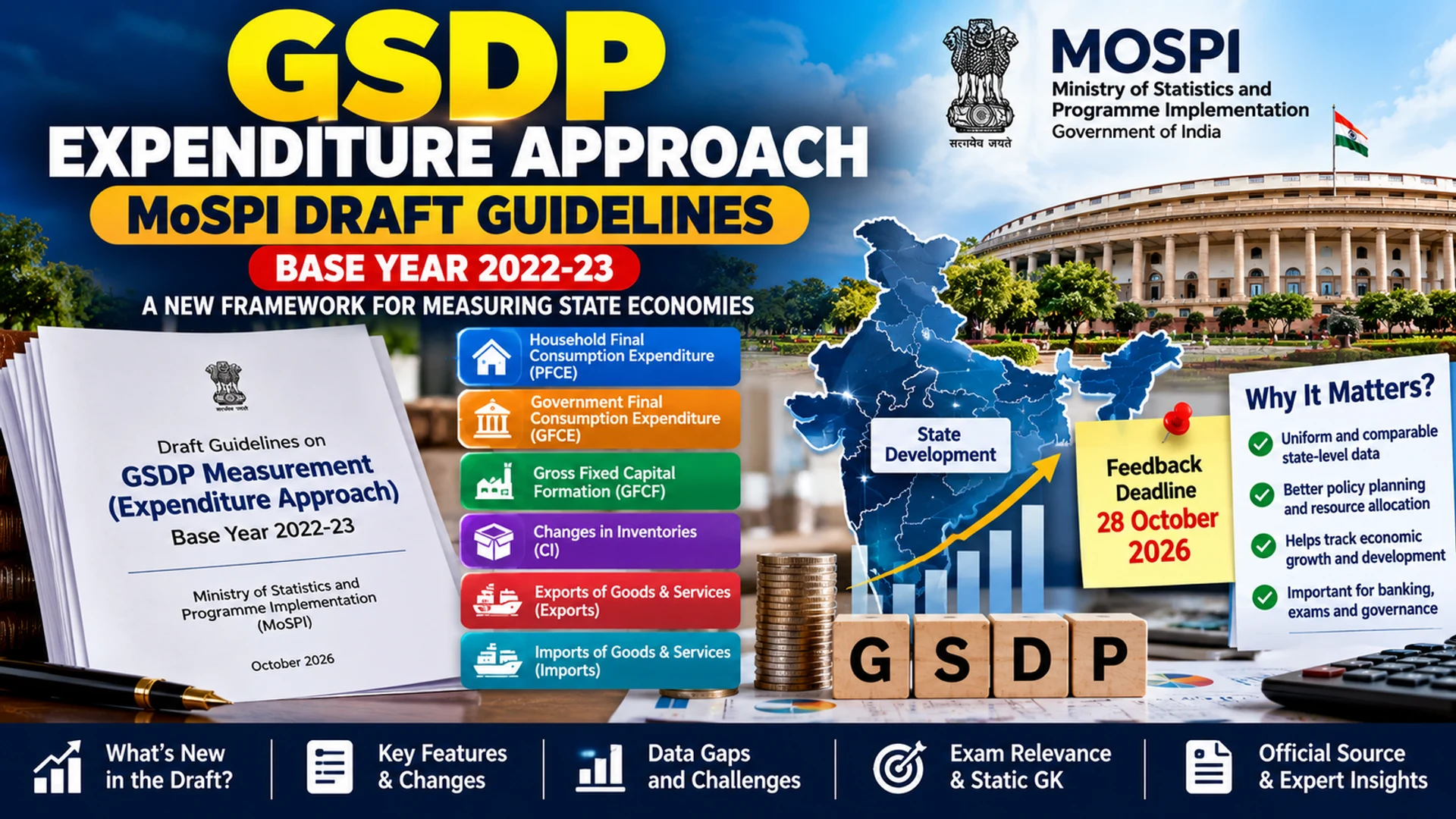
India’s statistics ministry has released draft guidance for States and Union Territories to estimate Gross State Domestic Product (GSDP) from the expenditure side using 2022–23 as the base year. The National Statistics Office (NSO), under the Ministry of Statistics and Programme Implementation (MoSPI), published the announcement on 9 October 2026 and invited feedback on the draft by 28 October 2026.
The important point is methodological, not a new ranking of State economies. The draft aims to make expenditure-side estimates more consistent and comparable. MoSPI says no State or Union Territory currently compiles Private Final Consumption Expenditure (PFCE) estimates at State level, while some already compile Government Final Consumption Expenditure (GFCE) and Gross Fixed Capital Formation (GFCF). The new framework is meant to help State statistical offices develop estimates using appropriate local data and allocation indicators where direct data are not available.
What happened?
On 9 October 2026, the NSO released draft guidelines for compiling GSDP estimates from the expenditure side with base year 2022–23. The draft sets out concepts, coverage, data sources, estimation procedures and methods for the main expenditure components. It is available through the official MoSPI documents page; comments from stakeholders are invited by 28 October 2026.
The release is a draft-guideline stage. It should not be reported as a final notification that every State has already adopted, nor does it announce the latest GSDP growth rate for any individual State. Its immediate purpose is to standardise the method used to build the estimates.
Why it matters
GSDP is commonly used to describe the size of a State’s economy. But producing a reliable estimate requires more than adding up the turnover of a few large sectors. Economists can estimate economic activity from different angles. The production approach looks at value added by industries; the income approach looks at incomes generated; and the expenditure approach examines final spending on goods and services produced in the economy.
These approaches should broadly tell a consistent story, although the source data and practical estimates can differ. Adding a more systematic expenditure-side view can help analysts compare consumption, government demand, investment and the external balance of State economies. It can also provide a cross-check against estimates produced from the production or income side.
For policymakers, the breakdown matters because two States with similar headline GSDP may have different drivers. One might have a stronger contribution from household consumption; another might depend more on capital formation, government spending or exports. A better expenditure-side series can help researchers assess these differences, monitor change and ask more precise questions about the composition of growth. The framework also aims to improve comparability among States and Union Territories and align their statistical practice more closely with national-level accounts.
The six components of expenditure-side GSDP
The draft identifies six major components. Candidates should learn both the full forms and the economic meaning of each term.
| Component | What it captures | Why it matters |
|---|---|---|
| Private Final Consumption Expenditure (PFCE) | Household and other private final spending on goods and services | Helps indicate consumption demand and living-standard-related activity |
| Government Final Consumption Expenditure (GFCE) | Government spending on final goods and services, as defined in national accounts | Captures the consumption role of government in the economy |
| Gross Fixed Capital Formation (GFCF) | Investment in fixed assets such as buildings, machinery and infrastructure | Provides information about capacity-building investment |
| Changes in inventories | Changes in stocks of goods held by businesses | Inventory accumulation or drawdown can affect measured expenditure |
| Valuables | Acquisitions of certain high-value items held as stores of value, as classified in national accounts | Separates these items from ordinary consumption or fixed investment |
| Net exports | Exports minus imports under the relevant accounting framework | Shows how transactions with the rest of the economy affect the expenditure total |
A commonly used macroeconomic identity is expressed as consumption plus investment plus government spending plus exports minus imports. That shorthand is useful for learning the logic, but official national accounts treat components with defined coverage, valuation rules and adjustments. A State-level estimate must therefore use the prescribed methodology rather than simply add unrelated local indicators.
Background: the measurement gap in GSDP estimates
The most specific problem identified in the ministry’s release is that no State or Union Territory is currently compiling PFCE estimates, even though some already prepare estimates for GFCE and GFCF. This is not a minor detail. Household consumption is a major part of economic activity, but it is not always observed directly for each State using a complete and consistent set of accounts.
The draft therefore gives guidance for producing estimates with the best available State-specific data and suitable allocation indicators. When direct State-level information does not exist for a particular component, the methodology may recommend using an indicator to distribute or estimate a larger total across States. This can improve consistency, but it also requires careful interpretation: an allocated estimate is not the same as a complete direct observation from every household or business.
The use of State-specific source material is important because spending patterns, production structures and data availability vary across India. A single proxy may be inappropriate for every State. A consistent framework should define what is being measured while allowing the most relevant data to be used where feasible.
Base year 2022–23: what does it mean?
A base year is a reference period used in compiling and presenting economic statistics. It helps fix the reference structure for constant-price estimates and related comparisons, subject to the exact national-accounting procedures. Changing or updating the base year can allow statistical series to reflect shifts in the economy and the availability of better source data. The appearance of 2022–23 in the title does not mean that the draft is estimating only activity in that financial year; rather, it identifies the base-year framework specified for the estimates.
For exam preparation, keep three points separate: the base year named in this draft is 2022–23; the document is guidance for expenditure-side GSDP compilation; and the release is a draft open for stakeholder feedback, with 28 October 2026 as the stated feedback date. Do not confuse it with a national GDP growth forecast, a State-wise GSDP ranking or a policy announcement about fiscal transfers.
Who is responsible for the work?
The National Statistics Office sits under MoSPI, the Ministry of Statistics and Programme Implementation. At State level, the relevant statistical machinery includes State Directorates of Economics and Statistics (DESs), which compile and publish economic statistics. The guideline is intended to support their capacity to produce more harmonised estimates across States and Union Territories.
Better GSDP statistics can inform public planning and research, but the quality of the result depends on the sources and methods behind it. Consistency should not be mistaken for identical economic structure: comparable methods make differences easier to interpret; they do not make every State economy the same.
What changes now—and what does not
- What changes in the immediate step: a draft methodological framework has been placed in the public domain, with a deadline for comments.
- What the draft aims to improve: consistency, comparability, State-specific estimation and the coverage of expenditure components.
- What should not be assumed: all States already have complete PFCE estimates, every State has adopted the draft, or the announcement itself changes any State’s GSDP growth rate.
Exam relevance
This development is particularly useful for Banking Awareness, UPSC, SSC and State PCS economy sections. Questions can test the full form of GSDP, the agency that released the draft, the base year, the feedback deadline, the expenditure components and the difference between expenditure-side and production-side estimation. It can also appear in descriptive questions on the reliability of State economic data and evidence-based policymaking.
Static GK connection
GSDP is the State-level counterpart commonly used to describe economic output, while Gross Domestic Product (GDP) is the national aggregate. MoSPI is the ministry; the NSO is the statistical office involved in preparing official statistics; and State Directorates of Economics and Statistics contribute to State-level data. India’s capital is New Delhi, its currency is the Indian rupee, its President is Droupadi Murmu and its Prime Minister is Narendra Modi.
Possible MCQ areas
- Which ministry and office released the draft expenditure-side GSDP guidelines?
- Which base year is specified in the draft?
- By which date are stakeholders invited to submit feedback?
- What is the full form of PFCE, GFCE and GFCF?
- Which expenditure component is not currently compiled by any State/UT, according to the release?
- Why are allocation indicators recommended when direct State-level data are unavailable?
Official source
PIB / MoSPI: Release of Draft Guideline for Compilation of GSDP Estimates by Expenditure Approach with Base Year 2022–23, 9 October 2026. The draft is listed on the official MoSPI documents page. Read the original document for the detailed procedures and submit comments through the official route where appropriate.