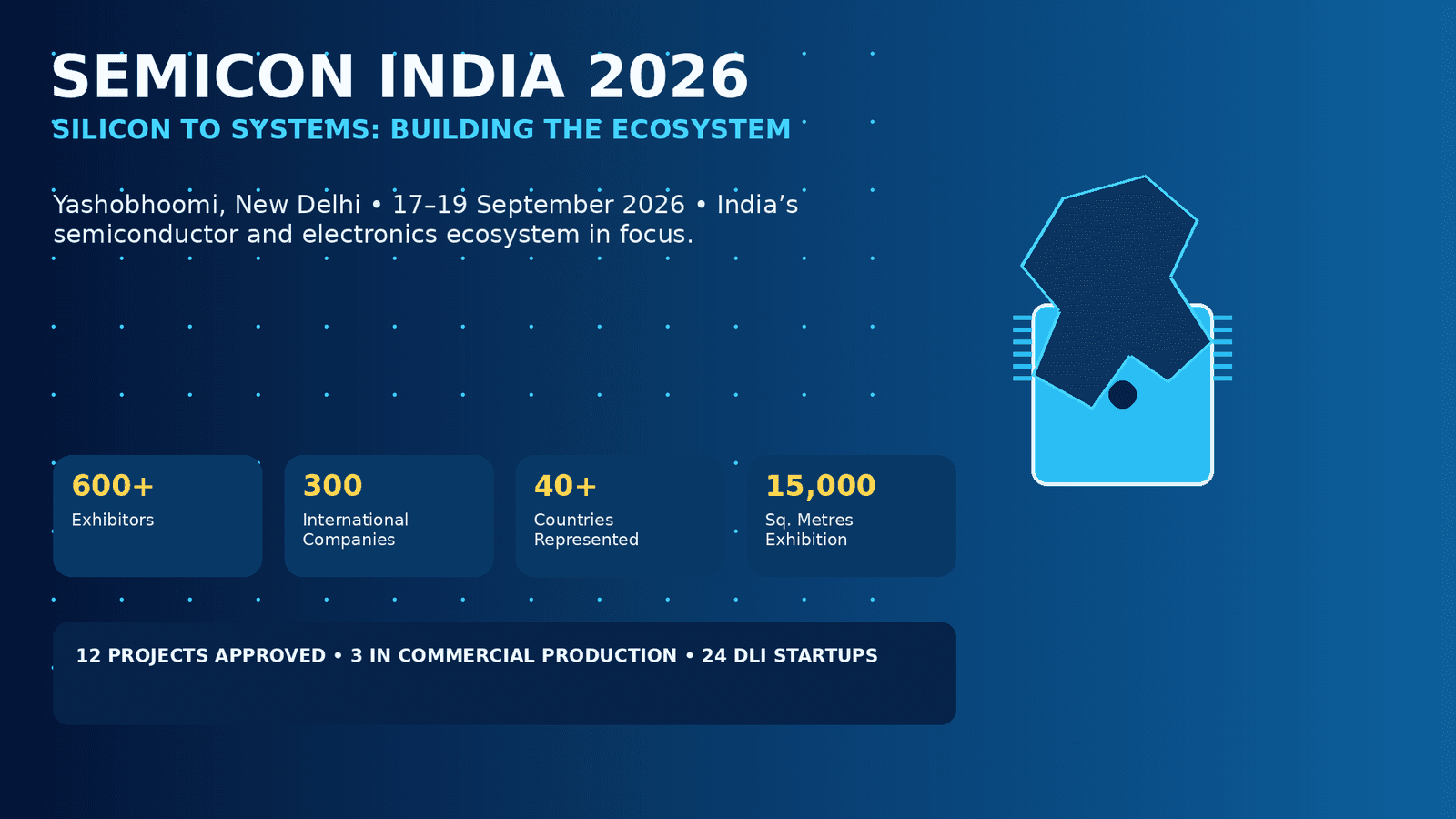
SEMICON India 2026, the fifth edition of the country’s major semiconductor industry event, begins on 17 September 2026 at Yashobhoomi, New Delhi and continues through 19 September. The event brings semiconductor manufacturers, equipment suppliers, investors, researchers, startups, policymakers and technology companies together around the theme Silicon to Systems: Building the Ecosystem.
SEMICON India 2026 at a Glance
| Indicator | Figure |
|---|---|
| Edition | Fifth |
| Dates | 17–19 September 2026 |
| Venue | Yashobhoomi, New Delhi |
| Exhibitors | 600+ |
| International companies | 300 |
| Countries represented | 40+ |
| Exhibition area | 15,000 sq. metres |
| Speakers | 150+ |
| Country pavilions | 6 |
| State pavilions | 12 |
| Startups in dedicated pavilion | About 40 |
The event is jointly organised by the India Semiconductor Mission, Ministry of Electronics and Information Technology and SEMI. Its structure covers the wider semiconductor value chain instead of focusing only on chip fabrication.
From Sand to Silicon to Systems
The exhibition includes a Sand to Silicon to Systems Value Chain Experience. This format connects the stages involved in building a semiconductor ecosystem: materials, manufacturing, packaging, testing, equipment, chip design, research and electronics systems.
This distinction is important because a semiconductor industry cannot become self-sufficient through wafer fabrication alone. Equipment, specialised materials, packaging and testing facilities, design capability and skilled manpower all determine whether a domestic manufacturing ecosystem can operate at scale.
Semiconductor Projects Approved under the National Programme
The government says 12 semiconductor projects have been approved under the Semicon India Programme. Of the projects approved under Semicon 1.0, three have commenced commercial production.
The difference between an approved project and one already producing commercially is important in measuring implementation. Approval records a committed project; commercial production indicates that an operational facility has reached production activity.
Semicon 2.0 and the Next Phase
The event also coincides with the next phase of the India Semiconductor Mission. The Union Cabinet has approved Semicon 2.0, structured around six major pillars aimed at expanding India’s semiconductor capabilities.
The broader strategy covers manufacturing as well as design, research, technology development, supporting equipment and other ecosystem requirements. This is intended to create a connected semiconductor value chain rather than isolated production plants.
Design Capability and Startups
Electronic design automation tools have been made available to more than 400 academic institutions and 105 startups, according to the official release.
Under the Design Linked Incentive Scheme, 24 startups have been approved to work on semiconductor products and applications. These numbers are relevant because semiconductor capability depends on intellectual property and chip-design capacity as much as on fabrication infrastructure.
India’s Semiconductor Demand
India’s semiconductor demand is estimated at around US$50 billion at present and is projected to reach about US$103 billion by 2030. The official event backgrounder places the global semiconductor market at around US$796 billion in 2025 and expects it to exceed US$2 trillion by 2030.
Demand is being supported by artificial intelligence, electric mobility, telecommunications, consumer electronics and other technology-intensive sectors. Each of these markets increases demand for processors, power-management chips, sensors, memory, communication components or specialised semiconductor systems.
Exam-Relevant Facts
- Event: SEMICON India 2026
- Dates: 17–19 September 2026
- Venue: Yashobhoomi, New Delhi
- Theme: Silicon to Systems: Building the Ecosystem
- Exhibitors: 600+
- International companies: 300
- Countries: 40+
- India semiconductor demand: about US$50 billion
- Projected demand by 2030: about US$103 billion
- Approved semiconductor projects: 12
- Projects in commercial production: 3
- DLI-approved startups: 24
Source: Ministry of Electronics and Information Technology and Press Information Bureau, Government of India.