Foreign Exchange Management for SBI JIBO
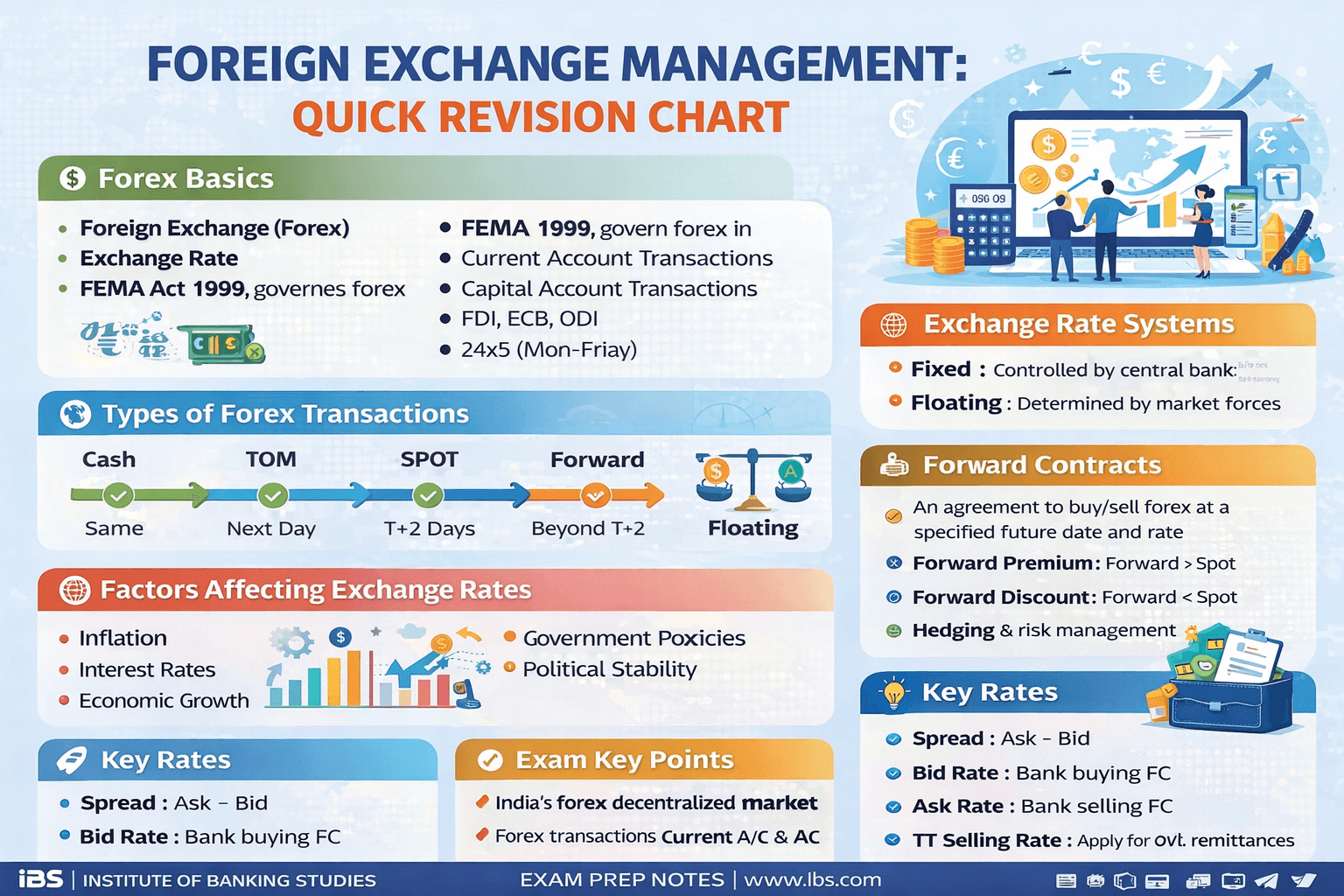
Foreign exchange management is a core banking topic covering exchange rates, forex transactions, hedging, accounts and the regulatory framework in India. These notes are arranged for quick SBI JIBO revision and competitive banking exams.
Related SBI JIBO reading: SBI JIBO Exam Preparation Guide 2026 · Treasury Management notes · Treasury Management Part 2.
🔹 1. Introduction to Foreign Exchange
Foreign Exchange (Forex): Conversion of one currency into another.
Foreign Transaction: Contract to exchange currencies between parties.
Exchange Rate: Price of one currency in terms of another.
📌 Importance
Facilitates international trade (exports & imports)
Supports travel, tourism, remittances
Maintains global financial integration
Helps build Forex Reserves (critical for economic stability)
🔹 2. Regulatory Framework (India)
✅ FEMA 1999 (Foreign Exchange Management Act)
Governs foreign exchange transactions in India.
Objective: Facilitate trade & payments + maintain forex market order
🔸 Types of Transactions
Current Account Transactions
Trade payments, services, remittances
No RBI approval (generally)
Capital Account Transactions
Affect assets/liabilities across borders
Includes:
FDI (Foreign Direct Investment)
ECB (External Commercial Borrowings)
ODI (Overseas Direct Investment)
🔹 3. Participants in Forex Market
RBI – Regulator & market stabilizer
Commercial Banks – Core intermediaries
Corporates – Importers/exporters
Investment Banks – Global trading
Individuals (NRI/HNI) – Investment, travel
Forex Dealers & Brokers (FEDAI)
🔹 4. Features of Forex Market
Highly liquid market
24×5 trading
Decentralized
Low transaction cost
High volatility
Used for hedging & speculation
🔹 5. Exchange Rate System
📊 Types:
Fixed Exchange Rate
Controlled by central bank
Example: UAE Dirham pegged to USD
Floating Exchange Rate
Determined by market forces
India follows managed float since 1993
🔹 6. Factors Affecting Exchange Rate
Inflation differential
Interest rates
Trade balance (deficit/surplus)
Economic growth
Government policies
Political stability
Global events
🔹 7. Exchange Rate Quotations
📌 Direct Quote
1 FC = HC
Example: USD/INR = 86.50
📌 Indirect Quote
1 HC = FC
Example: INR/USD
📌 Key Rates:
Bid Rate: Bank buys currency
Ask Rate: Bank sells currency
Spread: Difference between bid & ask
🔹 8. Types of Forex Transactions
| Type | Settlement |
|---|---|
| Cash | Same day |
| Tom | Next day |
| Spot | T+2 days |
| Forward | Beyond T+2 |
🔹 9. Forward Rates & Premium/Discount
Forward rate = Spot rate ± Forward points
Determined by interest rate differential
📌 Concepts:
Premium: Forward > Spot
Discount: Forward < Spot
🔹 10. Forex Accounts
Nostro Account: Our account abroad
Vostro Account: Foreign bank’s account with us
Loro Account: Third-party account
Mirror Account: Reconciliation copy
🔹 11. Forex Rates in Banking
TT Buying Rate
TT Selling Rate
Bills Buying Rate
Bills Selling Rate
Used in:
Imports/exports
Remittances
Bill settlements
🔹 12. Arbitrage & Hedging
🔸 Arbitrage
Risk-free profit from price differences across markets
🔸 Hedging
Protection against exchange rate risk
Done using forward contracts, options, swaps
🔹 13. Currency Swap
Exchange of currencies between two parties
Used for:
Hedging
Reducing borrowing cost
Speculation
🔹 14. Cross Rate & Chain Rule
Used when direct exchange rate not available
Derived via third currency (usually USD)
🔹 15. RBI & FEDAI Guidelines
🔸 RBI
Issues Authorized Dealer (AD) licenses
Regulates forex transactions
🔸 FEDAI
Sets operational rules for banks
Guidelines on:
Rates
Settlement
Forward contracts
Penalties
🔹 16. Important Exam Concepts (Highly Scoring)
Spot = T+2 settlement
Spread = Bid – Ask
Forward rates depend on interest rate differential
Most traded pair: EUR/USD
Forex market operates 24 hours
Nostro = Our money abroad
🔹 17. Practical Problems (Must Practice)
Forward rate calculation
Cross rate using chain rule
Exchange arithmetic (TT buying/selling)
Premium/discount identification
🔹 18. Advanced Topics (For Competitive Edge)
Currency futures & options
Balance of Payments (BoP)
Forex reserves management
Capital convertibility
Risk management techniques (VaR, hedging strategies)