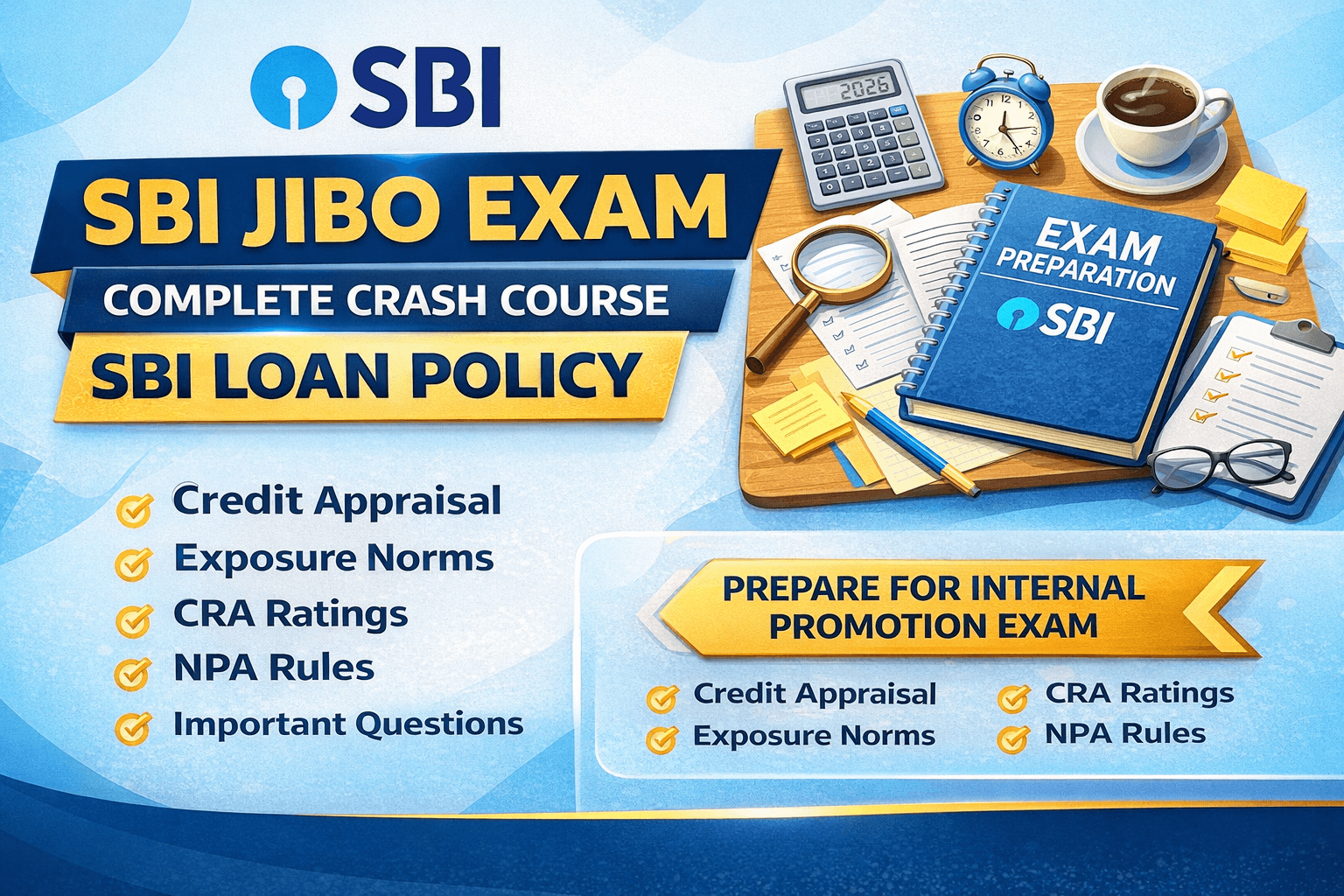
SBI JIBO Exam Preparation Guide 2026
This SBI JIBO exam preparation guide brings together key concepts from loan policy, exposure norms, credit appraisal, working capital, credit risk, NPA management and digital lending. Use the modules for concept building and the final revision section for quick recall before the exam.
Related SBI JIBO resources: PMLA, KYC, AML & CFT Banking Notes · Priority Sector Lending (PSL) notes · Treasury Management notes.
MODULE 1 — OVERVIEW OF SBI LOAN POLICY
Meaning of Loan Policy
Loan policy is the formal framework governing sanction, monitoring, and management of loans and advances in the bank.
Objectives:
Maintain sound credit portfolio
Ensure risk-controlled lending
Maintain prudential exposure limits
Align with RBI regulatory norms
Maintain ethical lending practices
The loan policy provides the overall framework for management of the bank’s loan portfolio and product creation.
Important Points for Exam
Loan policy:
• Reviewed annually by Board
• Implemented through Credit Policy & Procedures Committee (CPPC)
• Applies to domestic and international operations
MODULE 2 — SBI BUSINESS VERTICALS
SBI uses a segmented credit management structure.
Major Vertical Groups
| Vertical | Function |
|---|---|
| RBBO | Retail loans |
| CCG | Mid corporate clients |
| CAG | Large corporates |
| IBG | International operations |
| SARG | NPA resolution |
| PF&S SBU | Project finance |
| ABU | Agriculture finance |
| FI & MC | Financial inclusion |
These vertical structures help manage credit risk and specialized lending segments.
High Probability Question
Which group handles stressed assets?
Answer: SARG
MODULE 3 — EXPOSURE NORMS
Definition
Exposure = Total credit risk the bank has on a borrower.
Includes:
Fund based credit
Non-fund based credit
Investments
Derivative exposure
Defined under Exposure Norms and Credit Risk Concentration.
Types of Exposure
Fund Based
Examples:
Term loans
Cash credit
Overdraft
Non Fund Based
Examples:
Bank guarantee
Letter of credit
Derivative exposure
MODULE 4 — LARGE EXPOSURE FRAMEWORK (RBI)
Exposure Limits
| Borrower Type | Limit |
|---|---|
| Single borrower | 20% of Tier 1 capital |
| Group borrower | 25% of Tier 1 capital |
These limits prevent excessive credit concentration.
Key Concept
Large borrower exposure is defined when total exposure ≥10% of Tier-1 capital.
MODULE 5 — BORROWER EXPOSURE LIMITS
Internal exposure ceilings also apply.
| Borrower | Maximum Exposure |
|---|---|
| Individual | ₹100 crore |
| Non-corporate entities | ₹250 crore |
These limits ensure diversification of credit risk.
MODULE 6 — CREDIT APPRAISAL PROCESS
Credit appraisal is the process of evaluating creditworthiness of borrower before sanction.
Appraisal Steps
Promoter evaluation
Financial analysis
Industry analysis
Security evaluation
Risk assessment
Compliance verification
Creditworthiness is assessed after considering promoter background, group exposure, industry risk, financial strength, and collateral coverage.
Key Elements in Appraisal
Integrity of borrower
Technical feasibility
Economic viability
Financial viability
Repayment capacity
MODULE 7 — WORKING CAPITAL ASSESSMENT
Methods Used
1 Turnover Method
Working capital requirement:
25% of projected turnover
Bank finance:
20%
Borrower contribution:
5%
2 Projected Balance Sheet Method
Used for larger borrowers.
Assessment based on:
Current assets
Current liabilities
Net working capital
3 Cash Budget Method
Used for:
Seasonal industries
Agriculture related sectors
MODULE 8 — CREDIT RISK ASSESSMENT (CRA)
SBI uses CRA model to evaluate borrower risk.
CRA considers:
Financial risk
Industry risk
Business risk
Management risk
External environment
CRA Rating Scale
| Rating | Meaning |
|---|---|
| SB1–SB8 | Strong borrowers |
| SB9–SB15 | Moderate risk |
| SB16 | NPA account |
CRA rating helps determine sanction decision and pricing.
MODULE 9 — EXTERNAL CREDIT RATING (ECR)
Borrowers with exposure above ₹50 crore must obtain rating from accredited agencies such as:
CRISIL
ICRA
CARE
India Ratings
MODULE 10 — REVIEW AND RENEWAL OF ADVANCES
Working Capital Limits
Validity:
✔ 12 months
Renewal required annually.
If Not Renewed
Account may become irregular or NPA.
Adhoc Limits
Validity:
✔ 90 days
Maximum extension:
✔ 180 days
MODULE 11 — TERM LOANS
Term loans finance long-term capital investments.
Examples:
Plant & machinery
Infrastructure
Housing loans
Education loans
Tenure
Maximum tenure:
✔ 30 years
Moratorium
Minimum moratorium:
✔ 15% of project life
MODULE 12 — DUE DILIGENCE
Before sanctioning credit, bank must verify:
KYC compliance
Promoter background
Credit bureau report
Defaulter list
CIBIL history
Financial statements
The loan proposal must be supported by request letter/application from borrower and proper documentation.
MODULE 13 — RESTRICTIONS ON LENDING
Bank cannot grant loans for:
Speculative purposes
Shell companies
Purchase of own shares
Illegal activities
Certain sensitive commodities
MODULE 14 — LOANS TO DIRECTORS
Under Banking Regulation Act:
Bank cannot grant loans to directors or entities where they have substantial interest without approval.
MODULE 15 — SENSITIVE COMMODITIES
Bank must exercise caution while lending against:
Sugar
Food grains
Oilseeds
Cotton
Margins may be prescribed depending on market risk.
MODULE 16 — NPA MANAGEMENT
Account becomes NPA when overdue exceeds 90 days.
Types of NPAs:
| Category | Description |
|---|---|
| Substandard | NPA < 12 months |
| Doubtful | NPA > 12 months |
| Loss asset | Unrecoverable |
MODULE 17 — MONITORING OF ADVANCES
Monitoring includes:
Stock statements
Financial statements
Inspection reports
Early warning signals
Risk rating review
MODULE 18 — DIGITAL LENDING
Digital loan products include:
Instant personal loans
Pre-approved retail loans
These follow automated business rule engines and digital monitoring systems.
MODULE 19 — IMPORTANT COMMITTEES
Key committees involved in credit decisions:
Credit Policy & Procedures Committee (CPPC)
Responsible for:
framing loan policy
product approval
credit guidelines
Corporate Centre Credit Committee (CCCC)
Approves large credit proposals.
Executive Committee of Central Board (ECCB)
Approves very large loans and deviations.
MODULE 20 — IMPORTANT NUMBERS (VERY IMPORTANT FOR EXAM)
| Topic | Key Value |
|---|---|
| Single borrower exposure | 20% Tier 1 |
| Group exposure | 25% Tier 1 |
| Working capital turnover | 25% |
| Borrower contribution | 5% |
| NPA overdue | 90 days |
| Adhoc limit validity | 90 days |
| Term loan tenure | 30 years |
MODULE 21 — QUICK EXAM REVISION
Memorize the following:
5 Key Credit Risks
1 Industry risk
2 Financial risk
3 Management risk
4 Market risk
5 Operational risk
5 Steps of Credit Appraisal
1 Promoter check
2 Financial analysis
3 Industry analysis
4 Security valuation
5 Compliance verification
MODULE 22 — MOST LIKELY QUESTIONS
1
Working capital under turnover method?
Answer: 25% of projected turnover
2
Exposure limit to single borrower?
Answer: 20% of Tier 1 capital
3
Validity of working capital limit?
Answer: 12 months
4
Account becomes NPA after?
Answer: 90 days overdue
5
Which group handles stressed assets?
Answer: SARG