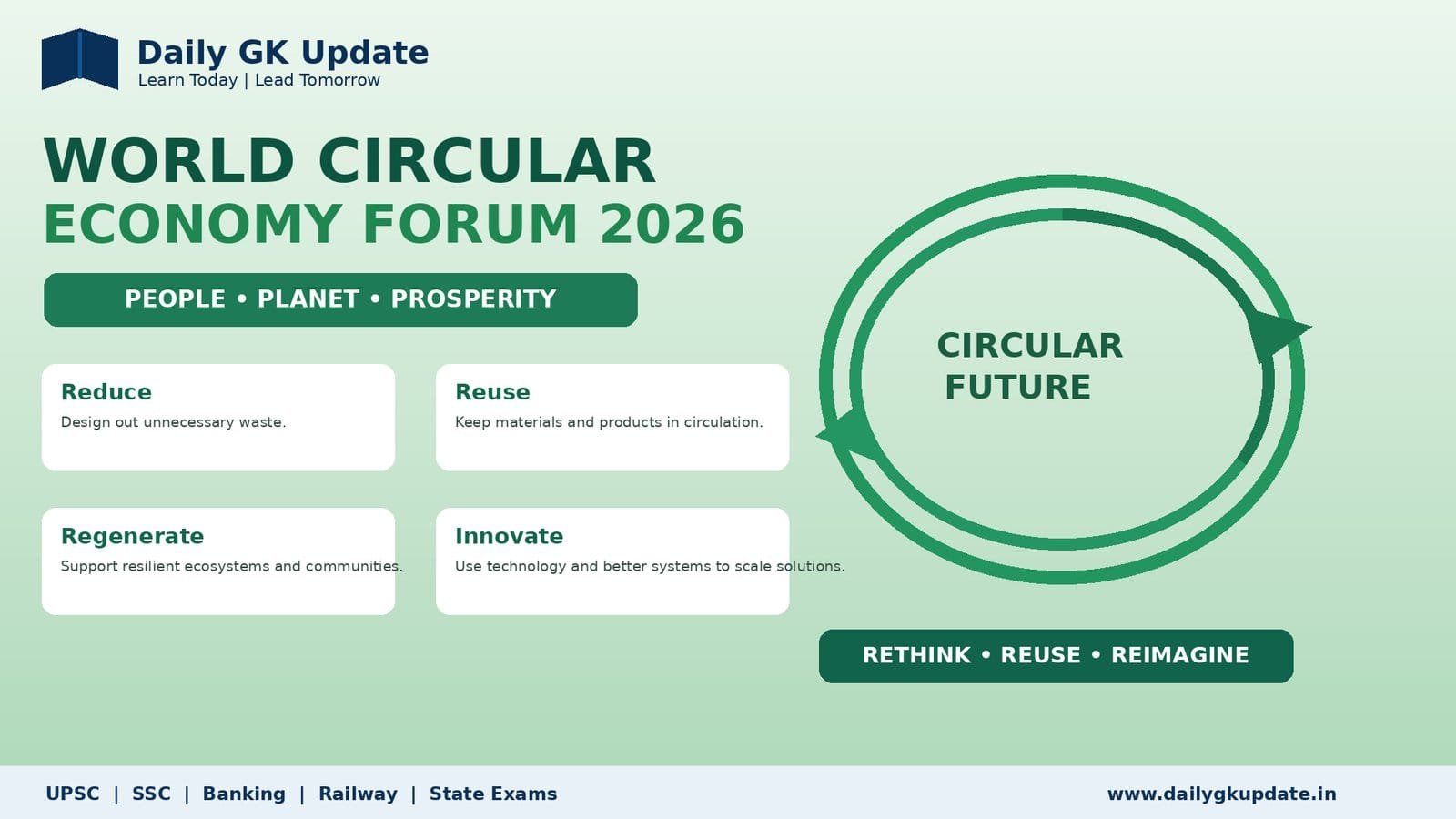
The World Circular Economy Forum 2026 (WCEF2026) is being held in Gandhinagar, Gujarat, from 15 to 18 September 2026. The tenth edition of the forum brings policymakers, businesses, researchers and other stakeholders together around practical circular-economy solutions. For UPSC, SSC and other competitive examinations, the event is useful because it connects environmental sustainability with industrial policy, resource security, innovation, jobs and global cooperation.
WCEF 2026: Key Facts
| Particular | Details |
|---|---|
| Event | World Circular Economy Forum 2026 |
| Edition | 10th |
| Dates | 15–18 September 2026 |
| Host city | Gandhinagar, Gujarat |
| Main venue | Mahatma Mandir Convention and Exhibition Centre |
| Theme | Circular economy: Transition for people and prosperity |
| Organising partnership | Sitra and India’s Central Pollution Control Board, with support from MoEFCC and Government of Gujarat |
What Is a Circular Economy?
A circular economy is an economic model designed to keep products, materials and resources in productive use for as long as possible. Instead of treating extraction, production, consumption and disposal as a one-way chain, circular systems emphasize durability, repair, reuse, refurbishment, remanufacturing, recycling and recovery of value.
The concept has direct links to India’s development priorities. Efficient material use can reduce dependence on virgin resources, limit waste generation, improve industrial resilience and support new business models. It is also relevant to climate action because the production of materials and products can involve significant energy use and emissions.
Why Gandhinagar Matters in 2026
WCEF2026 is taking place in India for the first time in South Asia. The official forum describes India as being positioned at the forefront of scalable circular-economy solutions for a resource-constrained world. Gandhinagar has been selected as the host city, with the main programme centred at Mahatma Mandir.
The forum is open online to participants worldwide, while in-person attendance is by invitation. The programme includes plenary discussions and parallel sessions focused on business, governance, industry, materials and practical circular solutions.
Why the Global South Is Important to the Circular Economy
One central issue in the WCEF2026 agenda is value creation in the Global South. The forum’s background material highlights the possibility of moving beyond the export of raw materials and developing circular industries that retain more economic value locally. This can include repair ecosystems, recycling, material recovery, product redesign, industrial symbiosis and technology-supported resource efficiency.
Connections With the Sustainable Development Goals
For examinations, remember that circular economy intersects strongly with responsible consumption and production, climate action, industry and innovation, decent work and economic growth, sustainable communities and partnerships. In an answer-writing question, the strongest approach is to explain how resource efficiency can create environmental and economic benefits together rather than treating circularity only as waste management.
Business and Employment Dimension
Circularity can generate new markets around product-life extension, maintenance, secondary materials, waste processing, remanufacturing and resource-efficient design. The forum’s own communication stresses economic resilience and local job creation as important parts of the transition.
Technology and Innovation
Modern circular systems increasingly depend on better tracking of materials, digital product information, advanced sorting and recycling, engineering for repairability, industrial data systems and new business models. Technology alone does not create circularity; policy, consumer behaviour, supply-chain design and investment also determine whether new solutions scale.
What Aspirants Should Remember
- WCEF2026 is the tenth edition.
- It is taking place in Gandhinagar, Gujarat.
- The forum runs from 15 to 18 September 2026.
- The theme is “Circular economy: Transition for people and prosperity”.
- India is hosting the forum for the first time in South Asia.
- Mahatma Mandir is the main venue.
How This Topic Can Appear in Exams
Questions may ask the host city, dates, theme or the meaning of circular economy. UPSC-style questions can go further and connect circularity with resource security, climate policy, industrial competitiveness and sustainable development. Descriptive answers should define the concept first, then discuss economic, environmental and social dimensions with Indian examples where appropriate.
Official Source
WCEF2026 official website • Practical information and venue
Last updated: 16 September 2026.