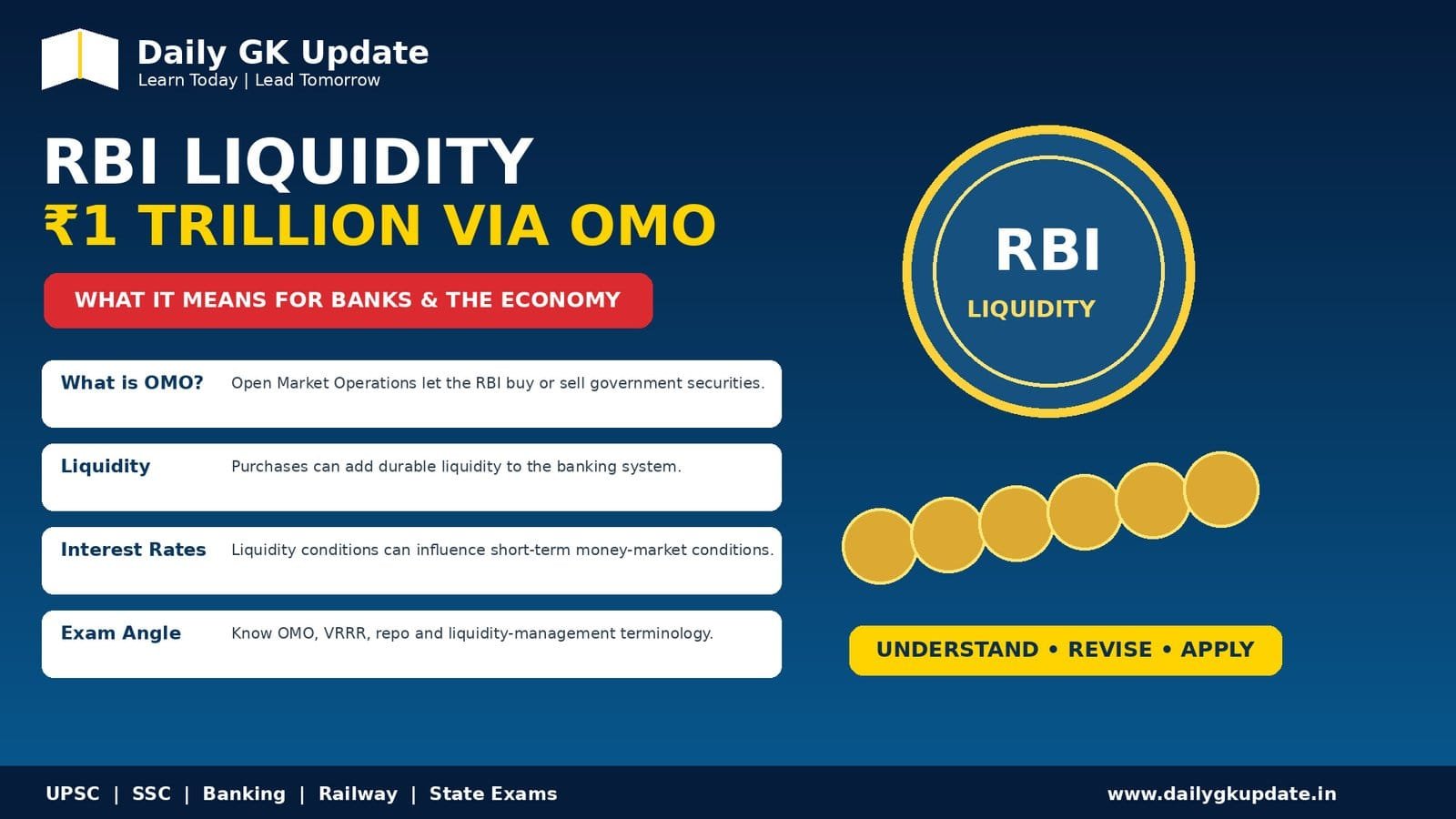
The Reserve Bank of India’s liquidity-management operations are an important banking-awareness topic this September because the central bank has planned ₹1 trillion of government-securities sales through open-market operations. The operation begins in the second half of September and is linked to surplus liquidity in the banking system after large foreign-currency inflows. For banking and finance aspirants, the story is useful because it combines Open Market Operations (OMO), liquidity absorption, government securities, money-market rates, foreign-exchange operations and inflation management.
What the RBI Has Announced
Reuters reported that the RBI announced open-market sales of government bonds totalling ₹1 trillion, with sales planned in tranches beginning on 16 September. The reported schedule includes ₹500 billion on 17 September and ₹250 billion each on 21 and 28 September. The securities being sold have maturities in the 2029–2032 range.
The central bank’s action comes after the banking system accumulated substantial surplus cash. The surplus has been associated with a strong response to the RBI’s special FCNR(B) foreign-currency mobilisation scheme, which brought large dollar inflows into the financial system.
What Is Liquidity Absorption?
Liquidity refers to readily available funds in the banking and financial system. When the system has excess liquidity, overnight and short-term money-market rates can fall. The central bank can respond by absorbing surplus funds through instruments such as variable-rate reverse repos, foreign-exchange sell-buy swaps or open-market sales of government securities.
In an OMO sale, the RBI sells government securities to market participants. Buyers pay for the securities, and the corresponding funds move out of the banking system. This reduces excess rupee liquidity. In an OMO purchase, the direction is reversed and liquidity is injected.
Why Did Surplus Liquidity Build Up?
The background is important for understanding the policy action. Large foreign-currency inflows can lead to domestic-currency liquidity entering the banking system when foreign exchange is converted and managed through the central bank’s operations. Reuters reported that the special FCNR(B) mobilisation scheme generated an unusually large response and contributed to elevated liquidity.
Excess liquidity is not automatically harmful, but when money-market rates move below the intended operating corridor or liquidity conditions become inconsistent with the monetary-policy stance, the RBI may need to absorb funds. The central bank’s objective is to keep market conditions aligned with its policy framework while responding to changing financial conditions.
OMO Sale vs OMO Purchase
| Operation | Effect on liquidity | Typical directional impact |
|---|---|---|
| RBI buys government securities | Liquidity increases | Supports system liquidity |
| RBI sells government securities | Liquidity decreases | Absorbs surplus funds |
How FX Swaps Fit Into the Picture
Before turning to bond sales, the RBI had also used foreign-exchange sell-buy swaps to absorb rupee liquidity. In a sell-buy swap, the central bank sells foreign currency in the spot leg and agrees to buy it back later. Such operations can absorb rupees initially while also influencing forward-market pricing and hedging incentives.
Reuters reported that recent swap operations were intended to help manage excess liquidity and could provide some indirect support to the rupee through higher forward premiums. The effectiveness of a specific operation depends on market demand and wider foreign-exchange conditions.
Why Government Bond Yields Matter
A large sale of government securities increases the supply of those bonds in the market. If demand does not fully absorb the additional supply without a price adjustment, bond prices can fall and yields can rise. This is why OMO sales matter to the government’s borrowing costs and the wider interest-rate structure.
For exam preparation, remember the basic bond-price relationship: bond prices and yields move in opposite directions, all else equal. A candidate should understand the mechanism rather than memorise only a current yield figure.
Banking Terms to Revise
- OMO: Purchase or sale of government securities by the central bank in the secondary market for liquidity management.
- VRRR: Variable Rate Reverse Repo, used to absorb liquidity for a specified period.
- FCNR(B): Foreign Currency Non-Resident (Bank) deposits denominated in permitted foreign currencies.
- Government Securities: Debt instruments issued by the central and state governments to raise funds.
- Liquidity Corridor: The framework around policy rates and standing facilities that helps guide short-term market rates.
Why the Topic Matters for Competitive Exams
SSC, banking and regulatory examinations can convert current monetary operations into conceptual questions. A question may ask whether an RBI bond sale injects or absorbs liquidity, what happens to bond yields when prices decline, why surplus liquidity can push overnight rates lower, or how an FX swap differs from an OMO.
Simple Memory Framework
Remember SELL = SUCK LIQUIDITY for an OMO sale. When the RBI sells securities, buyers send money to the market transaction and liquidity is withdrawn from the system. For an OMO purchase, the RBI sends funds into the market in exchange for securities, increasing liquidity.
Official and Primary References
Reserve Bank of India and the RBI’s official monetary-policy and market-operation communications should be checked for the latest operational details. The current ₹1 trillion operation and timing have also been reported by Reuters based on RBI announcements.
Editorial note: This article explains a current monetary-market development for educational use. It is not investment advice, and operational details can change as the RBI responds to market conditions.
Last updated: 16 September 2026.