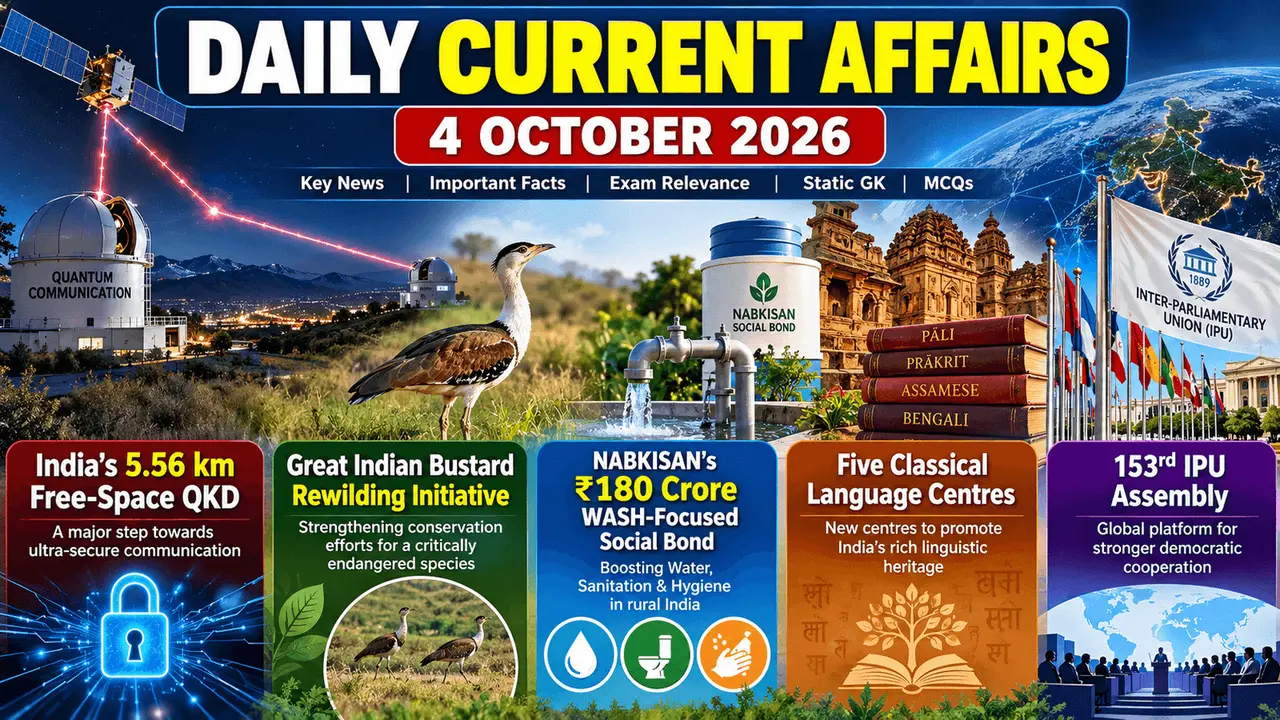
Daily Current Affairs 4 October 2026 is built around developments that can actually be revised and tested. Instead of repeating yesterday’s Asian Games-heavy coverage, today’s selection focuses on quantum communication, wildlife conservation, social finance, classical languages and India’s parliamentary diplomacy. The figures below are taken from government or institutional releases and are included because dates, amounts, distances and institutional names are often what competitive examinations turn into questions.
1. India demonstrates a 5.56 km free-space Quantum Key Distribution link
What happened?
India has demonstrated its first 5.56 km free-space Quantum Key Distribution (QKD) link in a field environment. The demonstration was carried out between BISAG-N and the Indian Institute of Technology Gandhinagar. The field trial took place during the night of 27–28 September 2026 and was reported by the Ministry of Electronics and Information Technology on 3 October.
The trial recorded a Quantum Bit Error Rate below 5% and a secure key rate of approximately 230–260 bits per second. The generated keys were integrated with the Vedic Kavach system at BISAG-N, which combines post-quantum cryptography, quantum random number generation and end-to-end encryption/decryption.
Why it matters
QKD is important because it uses quantum properties to detect attempts to intercept a key. In practical terms, the 5.56 km result matters less as a record distance than as a field demonstration over a free-space optical path. It moves the discussion from laboratory experiments toward deployable secure communications and creates a technical bridge toward longer terrestrial links and, eventually, satellite-based quantum communication.
| Measure | Demonstrated figure |
|---|---|
| QKD link | 5.56 km |
| Quantum Bit Error Rate | Below 5% |
| Secure key rate | 230–260 bps |
| Trial window | 27–28 September 2026 |
Background and static GK connection
Quantum Key Distribution is different from ordinary encryption. Conventional cryptography mainly depends on mathematical problems being difficult to solve, while QKD relies on quantum states and the fact that measurement can disturb the state being observed. A likely exam distinction is therefore: QKD distributes a key; it is not itself a complete encryption algorithm.
BISAG-N stands for Bhaskaracharya National Institute for Space Applications and Geo-informatics, while IIT Gandhinagar is located in Gujarat. The initiative is relevant to questions on quantum technology, cybersecurity, indigenous deep-tech capability and satellite communication.
2. Great Indian Bustard rewilding moves into the release stage
What happened?
The Ministry of Environment, Forest and Climate Change announced that the process of releasing captive-bred Great Indian Bustards (GIB) into the wild would begin at Desert National Park, Jaisalmer, Rajasthan. The Union Environment Minister Bhupender Yadav and Rajasthan Chief Minister Bhajan Lal Sharma initiated the process on 3 October, with the first two captive-bred birds scheduled for release on 4 October.
The programme is the result of a roughly 10-year conservation effort. The rewilding aviary at Ramdevra measures 160 metres × 64 metres × 14 metres and was sanctioned at ₹9.25 crore.
The captive-breeding facilities at Sam and Ramdevra together hold 97 birds: 40 originating from wild-laid eggs and 57 bred in captivity. Of these, 86 are being maintained for captive reproduction and 11 have been earmarked for the release programme. The programme reported 24 live chicks in 2025 and 29 in 2026.
Why it matters
The Great Indian Bustard is one of India’s flagship grassland species. It is the State bird of Rajasthan and is associated with the Thar landscape. Its conservation also matters beyond a single species because grassland protection supports a wider ecosystem and the bird is relevant to discussions on migratory routes, habitat loss and the interaction between wildlife conservation and infrastructure.
Background and static GK
The programme has used a “jumpstart” approach in which captive-laid eggs were placed in wild nests and accepted by wild females. Six chicks in Rajasthan and two in Gujarat were reported from this method. This is useful exam material because it combines ex-situ conservation—breeding or conservation outside the wild—with reintroduction or rewilding in natural habitat.
Remember the location link: Great Indian Bustard → Rajasthan → Thar ecosystem → Desert National Park. Questions can also connect the species with habitat fragmentation, overhead power lines and grassland conservation.
3. NABKISAN lists India’s first WASH-focused Social Bond
What happened?
NABKISAN Finance Limited, a subsidiary of NABARD, listed what the Ministry of Finance described as India’s first WASH-focused Social Bond on the NSE on 1 October 2026. The issue raised ₹180 crore and was oversubscribed 1.8 times.
The bond has a five-year tenor, carries an 8.10% coupon and is scheduled to mature in September 2031. The issue received CRISIL AAA/Stable and CARE AAA/Stable ratings. The proceeds are intended for projects involving water, sanitation and hygiene solutions for rural and underserved communities.
| Feature | Figure |
|---|---|
| Amount raised | ₹180 crore |
| Subscription | 1.8× |
| Coupon | 8.10% |
| Tenor | 5 years |
| Maturity | September 2031 |
Why it matters for banking and finance exams
This item is particularly useful for Banking Awareness because it links a NABARD subsidiary with the bond market and the social-finance framework. A Social Bond is designed to finance projects with defined positive social outcomes. The WASH label narrows that use of funds to water, sanitation and hygiene-related projects.
The relevant names are Dr Shaji Krishnan V, Chairman of NABARD, and Shri Immanuvel Ganesan, Managing Director & CEO of NABKISAN. The exam connection is straightforward: remember the parent institution, the amount, the coupon, the purpose of proceeds and the listing venue.
4. Five Centres of Excellence approved for Classical Languages
What happened?
The Ministry of Education approved five Centres of Excellence for Classical Languages. The locations and language specialisations are: Classical Assamese at Tezpur University, Classical Bengali at Visva-Bharati University, Classical Marathi at Deccan College Post-Graduate and Research Institute, Pune, Classical Pali at Central University of Odisha, and Classical Prakrit at Central University of Gujarat.
| Language | Centre of Excellence | State |
|---|---|---|
| Assamese | Tezpur University | Assam |
| Bengali | Visva-Bharati | West Bengal |
| Marathi | Deccan College | Maharashtra |
| Pali | Central University of Odisha | Odisha |
| Prakrit | Central University of Gujarat | Gujarat |
Why it matters
These centres are intended to strengthen research, preservation, digitisation and dissemination rather than simply act as ordinary academic departments. For exam preparation, this is a classic pairing exercise: language + institution + state. The locations also help revise the geographical spread of higher-education institutions across India.
A useful static connection is the difference between a language being recognised as a Classical Language and simply being an official or scheduled language. Classical status is associated with deep historical documentation and an old literary tradition; it should not be confused with the Eighth Schedule of the Constitution.
5. Indian parliamentary delegation heads to Tanzania for 153rd IPU Assembly
What happened?
An Indian parliamentary delegation led by Harivansh, Deputy Chairman of the Rajya Sabha, is scheduled to participate in the 153rd Assembly of the Inter-Parliamentary Union (IPU) in Arusha, Tanzania, from 5 to 9 October 2026. The Assembly theme is “Enhancing good governance and empowering communities through inclusivity, trust and opportunities for all.”
The Indian delegation includes members such as Anurag Singh Thakur, Aparajita Sarangi, Sasmit Patra, Sanjay Jaiswal, Kamaljeet Sehrawat, Lata Wankhede, Bijuli Kalita Medhi and N.K. Premachandran. Discussions are expected to cover issues including artificial intelligence, critical minerals and maritime security.
Why it matters
The IPU is an important institution for questions on parliamentary diplomacy and international organisations. It provides a forum for national parliaments to exchange views and cooperate on legislative and global governance issues. The India delegation therefore links current affairs with static polity and international relations.
Country GK: Tanzania
President: Samia Suluhu Hassan | Capital: Dodoma | Currency: Tanzanian shilling (TZS). The host country detail is worth remembering because examination questions often combine the event venue with the capital and currency.
Exam relevance: what to revise from today’s current affairs
For SSC and Railway examinations, memorise the high-precision facts: 5.56 km QKD, QBER below 5%, 230–260 bps, ₹9.25 crore GIB aviary, 97 captive birds, ₹180 crore WASH bond, 8.10% coupon, and the five Classical Language centres. For Banking exams, the NABKISAN–NABARD relationship and Social Bond details are especially useful. For UPSC and Defence exams, connect QKD with cybersecurity, the GIB programme with biodiversity policy, and the IPU assembly with parliamentary diplomacy.
Possible MCQ areas
- QKD distance, QBER and secure key rate in the MeitY demonstration.
- Great Indian Bustard: State bird of Rajasthan, Desert National Park and conservation methods.
- NABKISAN Social Bond: amount, coupon, tenor, purpose and parent institution NABARD.
- Language-to-institution matching for the five Centres of Excellence.
- IPU Assembly number, venue and Indian delegation leader.
Official sources
- Press Information Bureau — Government of India
- Ministry of Electronics and Information Technology
- Ministry of Environment, Forest and Climate Change
- Department of Financial Services, Ministry of Finance
- Rajya Sabha
Related articles
Daily Current Affairs 3 October 2026 — previous day’s exam-focused current-affairs roundup.
THE World University Rankings 2027 — higher-education facts and India’s ranking position.
GalaxEye OptoSAR Satellite 2026 — another deep-tech and space-focused current-affairs resource.
For the running index, use the Current Affairs Hub.