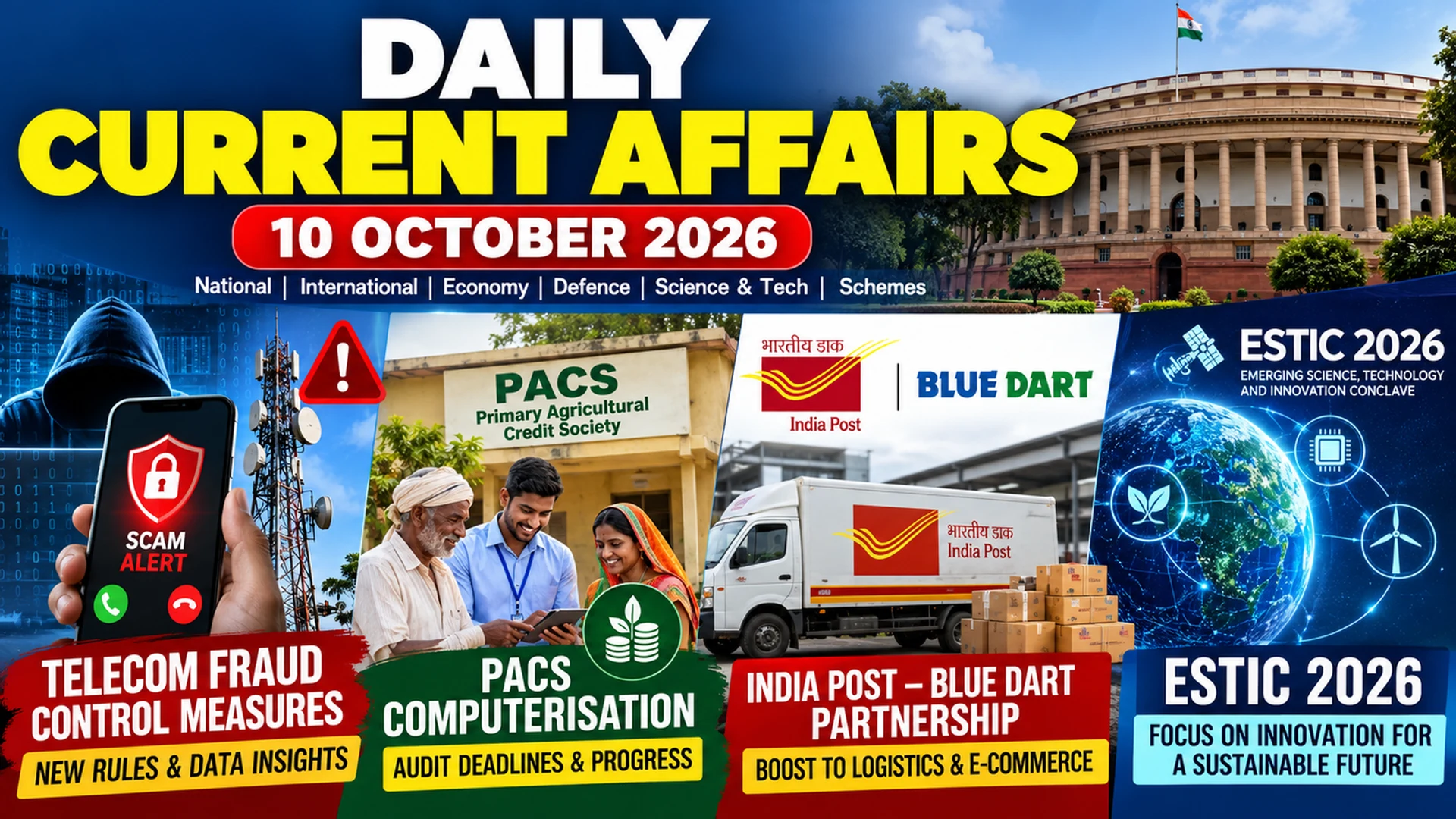
Daily Current Affairs — 10 October 2026 explains four official developments for SSC, Banking, Railways, UPSC and state exams: cross-border telecom-fraud controls, PACS computerisation and audit deadlines, the India Post–Blue Dart parcel partnership, and ESTIC-2026. It focuses on confirmed figures, responsible agencies, deadlines and what each release does—and does not—establish.
Quick revision: ASTR disconnected over 82 lakh fraudulent mobile connections; Sanchar Saathi reached 25 million downloads; DIP connects 1,600+ organisations; India Post has 1.64 lakh+ post offices; and PACS first-phase computerisation is due by December 2026.
1. India steps up action against cross-border telecom fraud
What happened?
At an International Telecommunication Union (ITU) roundtable on 9 October 2026, Union Minister of State for Communications and Rural Development Dr Chandra Sekhar Pemmasani welcomed a proposal for joint trials to combat cross-border telecom fraud. The discussion took place alongside the 10th India Mobile Congress 2026, inaugurated by Prime Minister Narendra Modi on 8 October at Yashobhoomi, New Delhi.
The government described a five-layered response: real-time blocking of spoofed international calls; detection of fraudulent mobile connections through C-DOT’s AI-based ASTR tool; citizen reporting through Sanchar Saathi; intelligence sharing through the Digital Intelligence Platform (DIP); and action against newer fraud channels. The minister said Indians lost more than ₹22,800 crore to such fraud in 2024, including impersonation, digital-arrest scams, AI-generated voice cloning and deepfakes.
Why it matters
Many scams exploit the gap between where a call or message appears to originate and who is actually behind it. A person may receive a call that appears to come from a domestic number even when the traffic has been manipulated from overseas. A fraudster may then impersonate a police officer, bank employee or government official and pressure the victim to transfer money. AI-generated voices and deepfakes can make the impersonation more convincing.
India’s approach combines network-level controls with public reporting and inter-agency intelligence. ASTR is intended to identify suspicious mobile connections; Sanchar Saathi gives citizens a way to report or check suspect communications and connections; and DIP enables participating institutions to exchange intelligence. The minister said DIP connects more than 1,600 organisations, including telecom operators, banks and law-enforcement agencies.
The Financial Fraud Risk Indicator (FRI) has helped prevent suspected financial losses exceeding ₹5,000 crore over 15 months, according to the ministry’s statement. This is a reported estimate of suspected losses prevented, not a claim that every attempted scam was stopped or that all fraud has been eliminated. The distinction matters when using official figures in an exam answer.
Key facts to remember
| Item | Official figure or role |
|---|---|
| Fraudulent mobile connections disconnected through ASTR | More than 82 lakh |
| Sanchar Saathi app downloads | Around 25 million |
| Organisations connected through DIP | More than 1,600 |
| Suspected losses prevented with FRI | Over ₹5,000 crore in 15 months |
| Reported loss from such fraud in 2024 | More than ₹22,800 crore |
The ITU proposal would explore cooperation among governments, regulators, telecom operators and technology companies, including digital verification of caller identity on selected international routes. It is a proposal for joint trials and standards work—not an announcement that a global caller-verification system is already operating everywhere.
2. Cooperative sector: PACS computerisation and audit deadlines
What happened?
The Ministry of Cooperation’s two-day 9th National Review Workshop concluded in Bastar, Chhattisgarh, on 9 October. The workshop, held on 8–9 October under the theme “Sahkar se Samriddhi — The Road Ahead: Scaling Impact through Cooperative Transformation,” reviewed cooperative credit, dairy, digitalisation, marketing and decentralised grain storage. Dr Ashish Kumar Bhutani, Secretary in the Ministry of Cooperation, urged States to translate discussions into time-bound action plans with named responsibilities and regular monitoring.
Two dates stand out for revision and implementation tracking: the first phase of Primary Agricultural Credit Societies (PACS) computerisation should be completed by December 2026, while audits for financial years 2024–25 and 2025–26 should be completed by October 2026. The existing computerisation scheme was scheduled to conclude in March 2027; the ministry said an extension proposal without additional financial implications had been sought to finish ongoing targets.
Why it matters
PACS are village-level cooperative institutions that provide members with access to credit and may support other rural services. Computerisation can improve record keeping, transaction visibility and the ability to connect local societies with wider cooperative-banking systems. But installing software alone is not enough: accurate ledgers, reconciliation, audits and reliable cyber controls are essential if the digital records are to be trusted.
The workshop also highlighted cybersecurity in cooperative banks and the need for a modern, more uniform Core Banking Solution (CBS) platform. The ministry said it was working with the Ministry of Finance and the Reserve Bank of India on cooperative-bank challenges, while NABARD’s platform initiative was nearing completion of the tendering process. Better internet and mobile banking services could help these institutions serve existing members and attract younger customers—but they need to be backed by safe systems and sound governance.
Officials cited a target of about 95,000 PACS over the next two to three years, through new societies, bifurcation and membership expansion. NCEL, NCOL and BBSSL were discussed as cooperative channels to aggregate produce and widen markets.
The workshop also considered decentralised grain storage and pledge finance as options for farmer credit and marketing; the Ministry said this would not replace the Minimum Support Price framework.
3. India Post and Blue Dart sign parcel-services agreement
On 9 October in New Delhi, the Department of Posts, under the Ministry of Communications, signed an agreement with Blue Dart Express Limited to strengthen parcel delivery. The arrangement is designed to combine India Post’s nationwide reach with Blue Dart’s express-logistics capabilities. The government says India Post operates more than 1.64 lakh post offices, giving the partnership a potential last-mile network in urban, semi-urban, rural and remote locations.
Planned features include prepaid and cash-on-delivery parcels, OTP-based delivery authentication and real-time tracking. The agreement is intended to support e-commerce and coordinate delivery operations; it does not yet quantify improved delivery times or volumes.
The agreement is confirmed, but the release does not give a delivery-time reduction, tariff schedule or nationwide rollout timetable. It is an example of public infrastructure paired with private last-mile logistics.
4. ESTIC 2026: science and innovation in focus
The Indian Council of Agricultural Research (ICAR) scheduled a curtain-raiser and media interaction for the Emerging Science, Technology and Innovation Conclave (ESTIC)-2026 on 10 October at the ICAR–Indian Institute of Farming Systems Research in Modipuram, Meerut, Uttar Pradesh. The main conclave is scheduled for 27–29 October 2026 at Bharat Mandapam, Pragati Maidan, New Delhi. Dr M. L. Jat, Secretary of the Department of Agricultural Research and Education and Director General of ICAR, was listed to address the curtain-raiser; Rajat Kumar Mishra, Secretary in the Department of Fertilizers, was listed for a special address. A green-ammonia technology demonstration was also planned during the field visit.
ESTIC links researchers, industry and policymakers around technology translation. For exams, retain its full form, dates, venue and host institutions; a curtain-raiser does not prove commercial deployment of a technology.
Background: why these developments matter together
All four updates concern public infrastructure: telecom fraud control needs coordination across networks, banks and enforcement agencies; cooperative reform needs reliable records; parcel partnerships link public reach with private logistics; and science conclaves connect research with policy and industry. Implementation and follow-through matter as much as the announcement.
Exam relevance
- Banking awareness: cyber fraud prevention, core banking solutions, cooperative banks, NABARD and digital customer services.
- Economy and governance: PACS, cooperative marketing, grain storage, pledge finance and the role of the Ministry of Cooperation.
- Science and technology: ITU, telecom standards, AI-generated impersonation, C-DOT and ESTIC.
- Logistics: Department of Posts, India Post’s network, cash-on-delivery, OTP verification and real-time tracking.
Static GK connection
India’s capital is New Delhi, its currency is the Indian rupee, its President is Droupadi Murmu and its Prime Minister is Narendra Modi. The Department of Posts falls under the Ministry of Communications; NABARD is the National Bank for Agriculture and Rural Development; and the ITU is the United Nations specialised agency for information and communication technologies.
Possible MCQ areas
- Which tool is used to identify fraudulent mobile connections, and which organisation developed it?
- How many organisations are connected through the Digital Intelligence Platform, according to the October 2026 statement?
- By when should the first phase of PACS computerisation be completed?
- Which two financial years’ PACS audits were asked to be completed by October 2026?
- How many post offices does India Post operate, according to the Department of Posts announcement?
- Where and when is ESTIC-2026 scheduled to be held?
Official sources
- PIB: ITU proposal and India’s telecom-fraud measures, 9 October 2026
- PIB: 9th National Review Workshop on cooperative transformation
- PIB: India Post–Blue Dart parcel-services agreement
- PIB: ICAR curtain-raiser ahead of ESTIC-2026