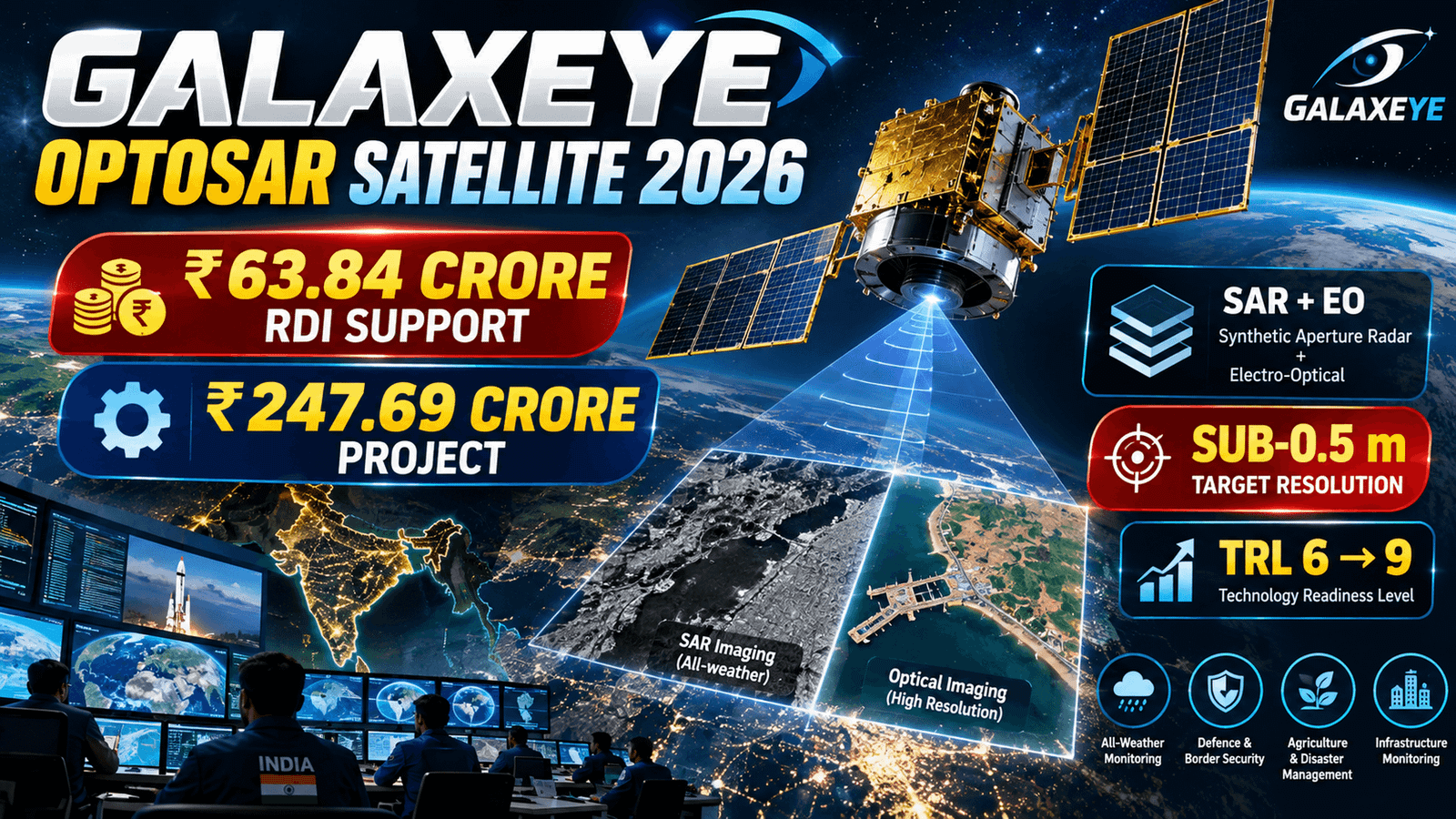
India’s private-space and deep-technology ecosystem received a major development on 24 September 2026 when the Technology Development Board (TDB), under the Department of Science & Technology, signed an agreement with GalaxEye Space Solutions Pvt Ltd, Bengaluru for ₹63.84 crore of support under the Research Development and Innovation (RDI) Fund. The project has a total approved cost of ₹247.69 crore and is designed to mature a multisensor satellite using OptoSAR imaging.
What Happened
The agreement supports an indigenous multisensor Earth-observation satellite targeting sub-0.5 metre resolution. The sensing architecture combines Synthetic Aperture Radar (SAR) with Electro-Optical (EO) imaging. The project is designed to move the technology from Technology Readiness Level 6 to Level 9 using government-backed R&D support.
Why It Matters
The key development is sensor fusion. Optical imaging can generate detailed visual information but conventional optical observation is affected by cloud and illumination. SAR uses radar and can operate in darkness and through cloud cover. Combining the two approaches is intended to provide more useful Earth-observation information across varied conditions.
Key Data
| Parameter | Figure |
|---|---|
| TDB-DST support | ₹63.84 crore |
| Total approved project cost | ₹247.69 crore |
| Target imaging resolution | Sub-0.5 metre |
| Technology maturity target | TRL-6 → TRL-9 |
| Core sensors | SAR + EO |
| Company | GalaxEye Space Solutions Pvt Ltd, Bengaluru |
Background: What is SAR?
Synthetic Aperture Radar is a radar-imaging technique that creates detailed information about the Earth’s surface using transmitted radar signals and the return signals recorded by the sensor. Unlike conventional optical imaging, SAR does not depend on daylight and can operate through cloud cover. This makes it valuable for persistent Earth observation.
What is Electro-Optical Imaging?
Electro-Optical sensors record reflected or emitted electromagnetic energy to create imagery with rich visual detail. In practical Earth observation, cloud, haze and illumination can affect what an optical sensor can see. This limitation explains the value of pairing EO observations with radar-based sensing.
Why the OptoSAR Combination Is Important
OptoSAR uses the two sensing families as complementary sources. An optical image can provide visual context while SAR can maintain observation when cloud or darkness limits optical visibility. The technical objective is therefore not simply to add two cameras; it is to combine different forms of information into a multisensor system.
Understanding TRL-6 to TRL-9
Technology Readiness Levels provide a standard way to describe how mature a technology is. A move from TRL-6 toward TRL-9 indicates progression from technology demonstrated in a relevant environment toward a fully demonstrated operational system. For an exam candidate, the important point is that the project is intended to cross the gap between a demonstrated technology and a deployment-ready system.
Potential Applications
- Wide-area surveillance.
- Long-range observation.
- Human and vehicle detection.
- Target classification.
- Earth observation under varied weather and lighting conditions.
Institutional Framework
The Technology Development Board functions under the Department of Science & Technology. The RDI Fund provides a public framework for supporting research, development, innovation and technology maturation. The GalaxEye agreement is therefore relevant to both India’s space ecosystem and the broader policy effort to move advanced technologies from development toward deployment.
Exam Relevance
This development is suitable for UPSC, SSC, banking awareness and defence examinations. Candidates can be tested on TDB, DST, RDI Fund, SAR, EO, OptoSAR, TRL levels and the three principal figures: ₹63.84 crore, ₹247.69 crore and sub-0.5 metre.
Static GK Connection
- TDB: Technology Development Board.
- DST: Department of Science & Technology.
- SAR: Synthetic Aperture Radar.
- EO: Electro-Optical imaging.
- Earth observation: Satellite-based observation and measurement of Earth’s surface and atmosphere.
Possible MCQ Areas
- Which company is developing the OptoSAR system? GalaxEye Space Solutions Pvt Ltd.
- How much RDI support is associated with the project? ₹63.84 crore.
- What is the total approved project cost? ₹247.69 crore.
- Which two sensing technologies are combined? SAR and EO.
- What is the targeted technology-readiness progression? TRL-6 to TRL-9.
Revision Chain
Remember the topic through one sequence: GalaxEye → TDB-DST → RDI Fund → ₹63.84 crore support → ₹247.69 crore project → OptoSAR → SAR + EO → sub-0.5 metre → TRL-6 to TRL-9.
Official Source
Press Information Bureau — Ministry of Science & Technology